Air-cooled engine systems, a seemingly outdated technology, still hold a significant place in the history of the automotive industry. This article delves into the working principles, advantages, disadvantages, applications, and future of air-cooled systems.
How Air-Cooled Engine Systems Work
Air-cooled systems operate based on the principles of natural and forced convection heat transfer. Cool air is directed over cooling fins surrounding the cylinders and engine block, absorbing heat from the engine and dissipating it into the environment. These fins are specifically designed to maximize surface area contact with the air, optimizing the cooling process. In forced-air systems, a fan increases airflow over the fins, enhancing cooling efficiency, especially at low speeds or when the vehicle is stationary.
Advantages and Disadvantages of Air Cooling
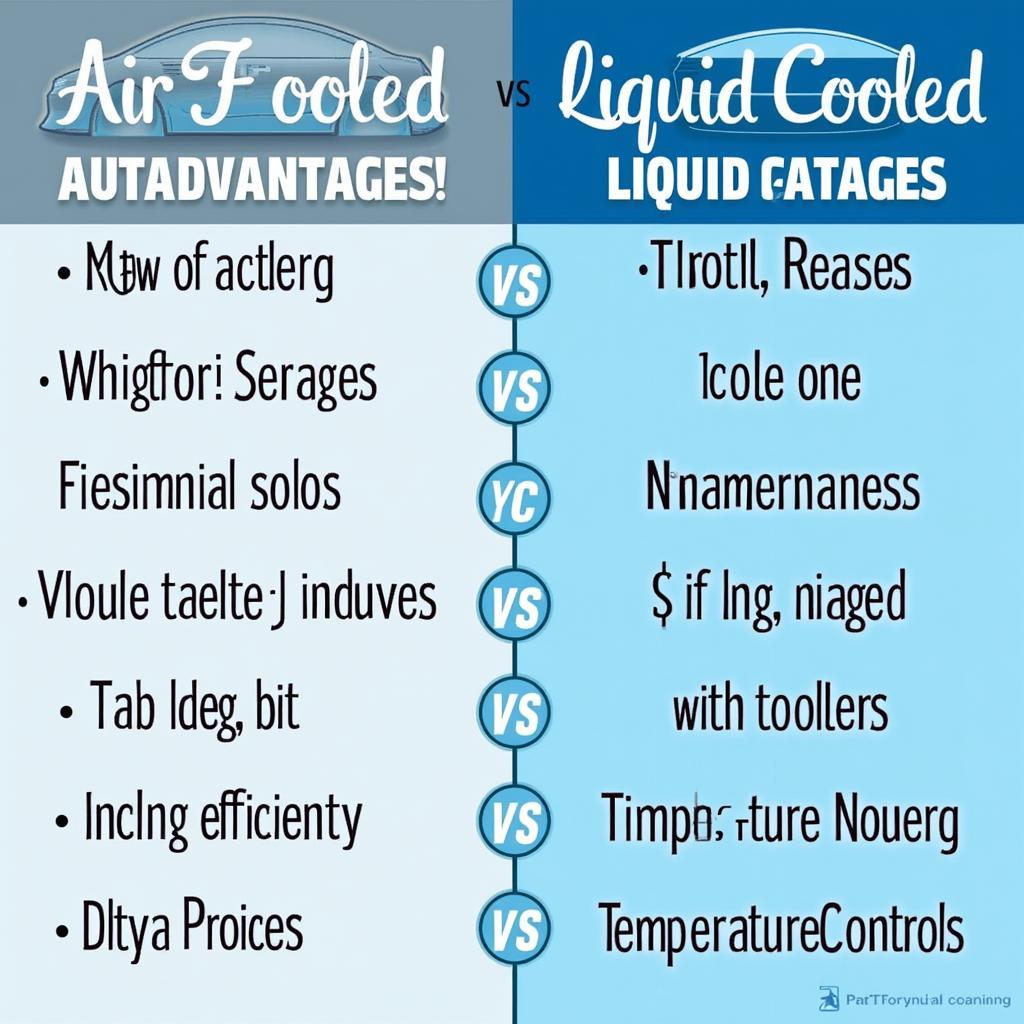
Air-cooled systems offer notable advantages such as simplicity, lightweight construction, no need for coolant, and minimal susceptibility to freezing temperatures. However, they also have drawbacks, including lower cooling efficiency compared to liquid-cooled systems, increased noise due to the cooling fan, and difficulty in precisely controlling engine temperature.
Diagram illustrating the pros and cons of air-cooled engine systems in cars.
Similar to [auto repair learning resources], understanding cooling systems is crucial. This knowledge provides a deeper understanding of vehicle structure and operating principles. This relates to [causes of poor car acceleration] as both concern engine performance.
Applications of Air-Cooled Engine Systems
Air-cooled systems were widely used in classic cars like the Volkswagen Beetle, early Porsche 911 models, and certain motorcycles. Today, their application has significantly decreased due to the advancement of liquid-cooled systems, which offer superior cooling efficiency and precise engine temperature control. However, air-cooled systems remain in use for specialized applications such as racing cars, small generators, and some industrial engines.
The Future of Air Cooling in the Automotive Industry
While air-cooled systems are unlikely to rival liquid-cooled systems in modern cars, research and development of new materials and advanced technologies may present new opportunities for this system in the future. For example, utilizing composite materials with better thermal conductivity and optimizing airflow design could significantly improve the cooling efficiency of the system.
Conclusion
Air-cooled engine systems in cars, although no longer prevalent, remain an important part of automotive history. With their unique advantages, these systems still hold potential for application in specific areas. To learn more about [introduction to automobiles], you can find further information on our website.
FAQ
- How does an air-cooled engine system work?
- What are the advantages of an air-cooled engine system?
- What are the disadvantages of an air-cooled engine system?
- What are the applications of an air-cooled engine system?
- What is the future of air-cooled engine systems?
- Compare air-cooled and liquid-cooled engine systems.
- Why are air-cooled engine systems no longer common?
For assistance, please contact us by phone: 0968239999, Email: [email protected] or visit us at: TT36 – CN9 Road, Tu Liem Industrial Zone, Phuong Canh Ward, Nam Tu Liem District, Hanoi. We have a 24/7 customer service team.









