“Your Dongfeng truck is running great! The tires still look brand new. What kind are they?” Mr. Tu, owner of a construction material shop on Nguyen Trai Street, chuckled: “Choosing tires is a science! You have to carefully examine the sidewall markings. You can’t just install any tire.” So, what’s the secret behind these markings? Let Xetaihanoi.edu.vn decode them for you!
Tire Sidewall Markings: Your Vehicle’s Secret Language
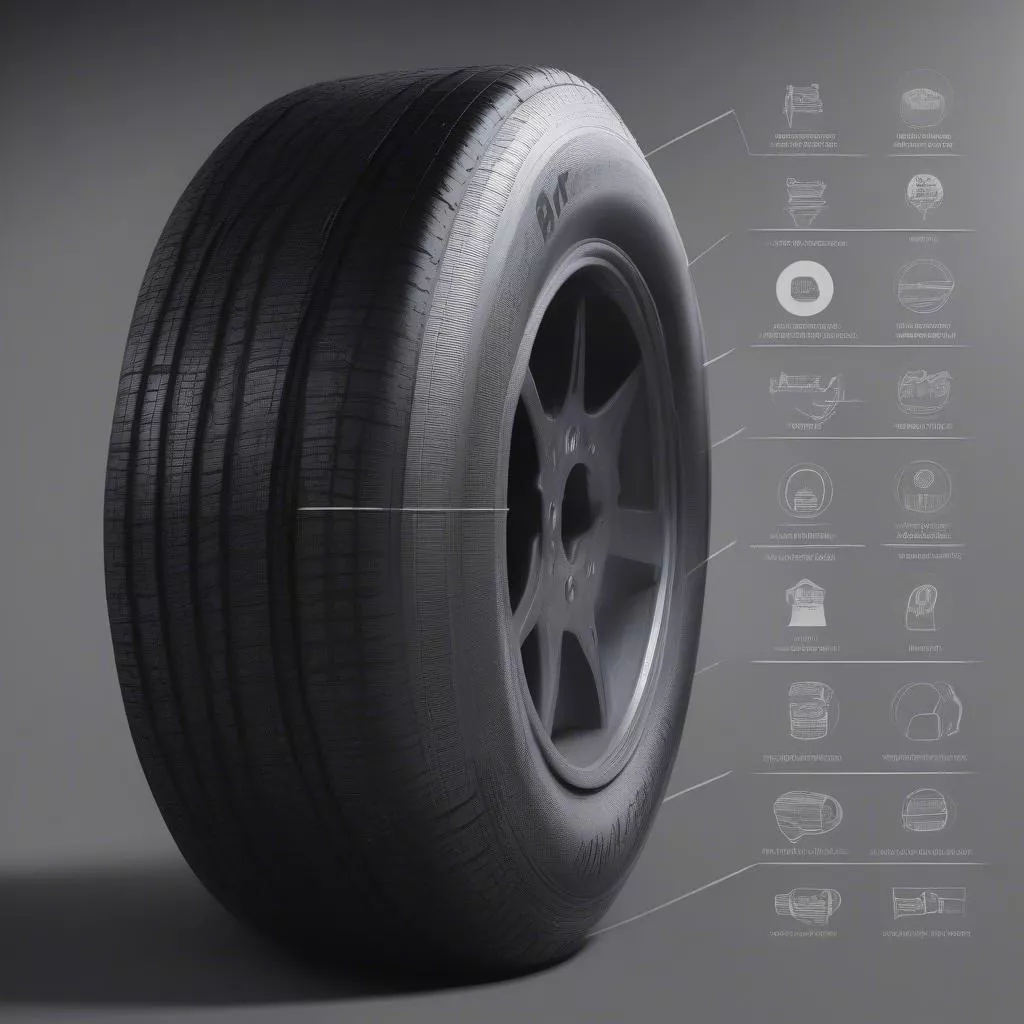
Tire sidewall markings are more than just a series of numbers and letters; they’re your vehicle’s secret language, providing crucial information about its “shoes.” Understanding these markings allows you to:
- Choose the right tires for your vehicle, ensuring safety and optimal performance.
- Understand load capacity and tire pressure limits, preventing dangerous overloads and blowouts, especially for heavy-duty trucks.
- Extend tire lifespan and save on replacement and maintenance costs.
Mr. Nguyen Van A, a technical expert at Hyundai Truck, shared: “Many vehicle incidents occur due to drivers not understanding tire markings. This poses significant risks, especially for trucks frequently traveling long distances.”
Types of Tire Sidewall Markings
1. Basic Information:
-
Tire Size: Represented by a series of numbers like 195/65R15, where:
- 195: Tire width (mm).
- 65: Aspect ratio (height to width percentage).
- R: Tire construction (Radial).
- 15: Wheel diameter (inches).
-
Load Index: A numerical code indicating the maximum weight a tire can carry. For example, an index of 91 corresponds to a load of 615kg/tire.
-
Speed Rating: Represents the maximum permissible speed for the tire, indicated by a letter (e.g., H – 210km/h).
-
Tire Construction: Indicates the arrangement of steel belts within the tire. The most common is Radial (R) – longitudinal steel belts providing durability and grip.
-
Maximum Tire Pressure: Indicated in PSI or kPa, representing the maximum pressure that can be inflated into the tire.
2. Additional Information:
Tires also feature additional markings such as:
- Manufacturer: Bridgestone, Michelin, Goodyear, etc.
- DOT Code: Provides information about the manufacturing location, week, and year of the tire.
- Tread Pattern: Tread patterns for wet, dry, or snowy conditions.
- Safety Standards: UNECE, FMVSS, etc.
Tire sidewall markings
Tire Load Index and Speed Rating Chart
For easy reference, Xetaihanoi.edu.vn provides a basic tire load index and speed rating chart:
| Load Index | Load Capacity (kg) | Speed Rating | Maximum Speed (km/h) |
|---|---|---|---|
| 80 | 450 | N | 140 |
| 85 | 515 | P | 150 |
| 90 | 600 | Q | 160 |
| 95 | 690 | R | 170 |
| 100 | 800 | S | 180 |
| 105 | 925 | T | 190 |
| 110 | 1060 | H | 210 |
| 115 | 1215 | V | 240 |
Note: This is a reference chart only. Always refer to the markings on your tires and the vehicle owner’s manual for the most accurate information.