Vietnam’s agricultural sector is undergoing a significant transformation, moving towards large-scale commodity production and high-tech applications. Mechanization plays a crucial role in this process, serving as the key to enhancing productivity, quality, and competitiveness. Recognizing this importance, the Vietnamese government has implemented various policies to support agricultural mechanization, facilitating farmers’ access to technology and modernizing production.
Benefits of Agricultural Mechanization
Mechanization is not merely about replacing human labor with machines; it offers numerous practical benefits for farmers and the agricultural sector:
- Increased Labor Productivity: Modern machinery reduces cultivation time, increases labor productivity, and frees people from strenuous tasks.
- Improved Product Quality: Advanced technology allows for better control of input factors, ensuring high-quality agricultural products that meet market demands.
- Reduced Production Costs: Efficient use of machinery saves on materials, fuel, and post-harvest losses, ultimately reducing production costs.
- Environmental Protection: Modern equipment often incorporates advanced technology, minimizing environmental pollution and promoting sustainable agriculture.
Financial Support
The government has enacted several policies to support agricultural mechanization, focusing on the following key areas:
- Preferential Credit Policies: Providing subsidized interest rates on loans for investing in agricultural machinery and equipment for individuals, cooperatives, and businesses.
- Machinery Purchase Subsidies: Offering price subsidies and partial support for the purchase of advanced agricultural machinery and equipment suitable for local production conditions.
- Investment Incentive Policies: Granting tax and land incentives to businesses investing in the production and trade of agricultural machinery and equipment.
Technical Support
- Human Resource Training Policies: Providing training and technical instruction on the operation, maintenance, and repair of agricultural machinery for farmers and technicians.
- Technology Transfer Policies: Supporting the transfer of advanced techniques and the application of new technologies in the production and manufacturing of agricultural machinery.
- Service System Development Policies: Establishing a network of technical services, supplying materials, and providing repair and maintenance for agricultural machinery.
Key Policies
- Decree No. 55/2015/ND-CP: Regulates policies supporting agricultural and rural development in ethnic minority and mountainous areas, including support for mechanization.
- Decision No. 68/2013/QD-TTg: Approves the Project on Restructuring the Agricultural Sector towards Enhancing Value Added and Sustainable Development, emphasizing the role of mechanization.
- Circular No. 23/2016/TT-BNNPTNT: Regulates investment management and support for the application of mechanization in agriculture, forestry, and fisheries.
Current Situation and Solutions
Despite achieving certain results, the implementation of policies supporting agricultural mechanization still faces some limitations:
- Limited Access to Information: Many farmers lack awareness of support policies, and administrative procedures remain complex.
- Limited Investment Resources: Access to preferential loans remains difficult, and the cost of machinery and equipment is still high compared to farmers’ income.
- Asynchronous Technical Service System: The network of repair, maintenance, and spare parts supply services does not adequately meet the demand.
To overcome these limitations, it is necessary to focus on the following solutions:
- Strengthening Communication and Dissemination: Bringing policies closer to the people, simplifying administrative procedures, and facilitating access for farmers.
- Promoting Investment Socialization: Mobilizing resources from various economic sectors to invest in agricultural mechanization.
- Improving Human Resource Quality: Training a team of highly qualified technical staff to meet the requirements of mechanization development.
- Developing a Synchronous Service System: Expanding the network of technical services, material supply, repair, and maintenance for agricultural machinery throughout rural areas.
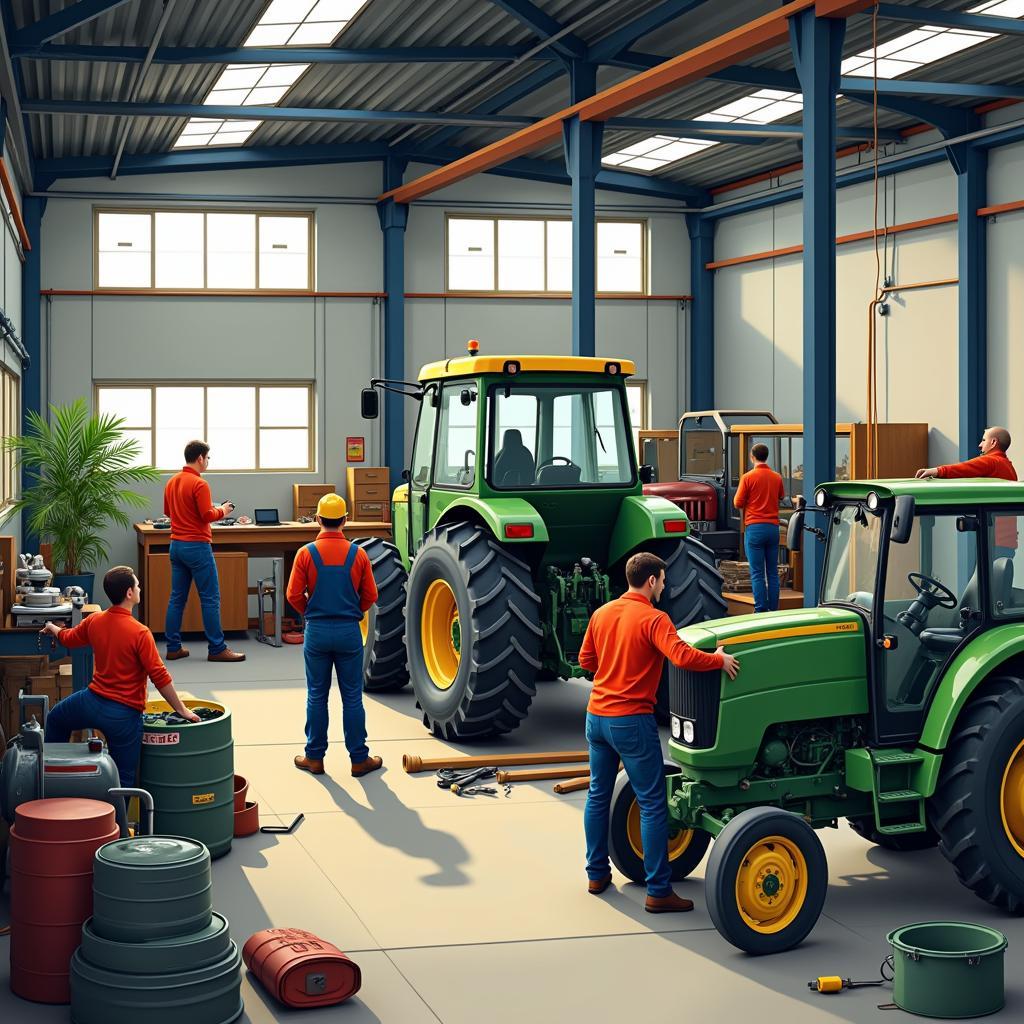
Agricultural machinery repair and maintenance service system ensures farmers' peace of mind.
Conclusion
Policies supporting agricultural mechanization play a vital role in promoting the modernization of Vietnam’s agricultural sector. Continuing to improve policies and enhance implementation effectiveness will contribute to increasing productivity, quality, and efficiency in agricultural production, improving farmers’ livelihoods, and contributing to the development of a modern, efficient, and sustainable agricultural sector.
Frequently Asked Questions
1. Who is eligible for agricultural mechanization support policies?
Agricultural mechanization support policies generally target individuals, households, cooperatives, and businesses operating in the agricultural sector.
2. How can I access preferential loans for investing in agricultural machinery?
Farmers can contact the Vietnam Bank for Social Policies, the Vietnam Bank for Agriculture and Rural Development, or other credit institutions to inquire about loan procedures.
3. What training programs are available for operating and repairing agricultural machinery?
The Ministry of Agriculture and Rural Development, universities, colleges, vocational schools, and training centers offer training courses on the operation and repair of agricultural machinery.
4. Do machinery purchase support policies apply to all types of machinery?
Support policies often focus on advanced machinery and equipment that align with the agricultural development orientation of each locality.
5. Besides financial support, are there other forms of support for agricultural mechanization?
In addition to financial support, the government also provides support in technical aspects, technology transfer, human resource training, and service system development.
Learn More About:
Contact us by Phone: 0968239999, Email: [email protected] or visit our address: No. TT36 – CN9 Road, Tu Liem Industrial Zone, Phuong Canh Ward, Nam Tu Liem District, Hanoi. We have a 24/7 customer service team.









