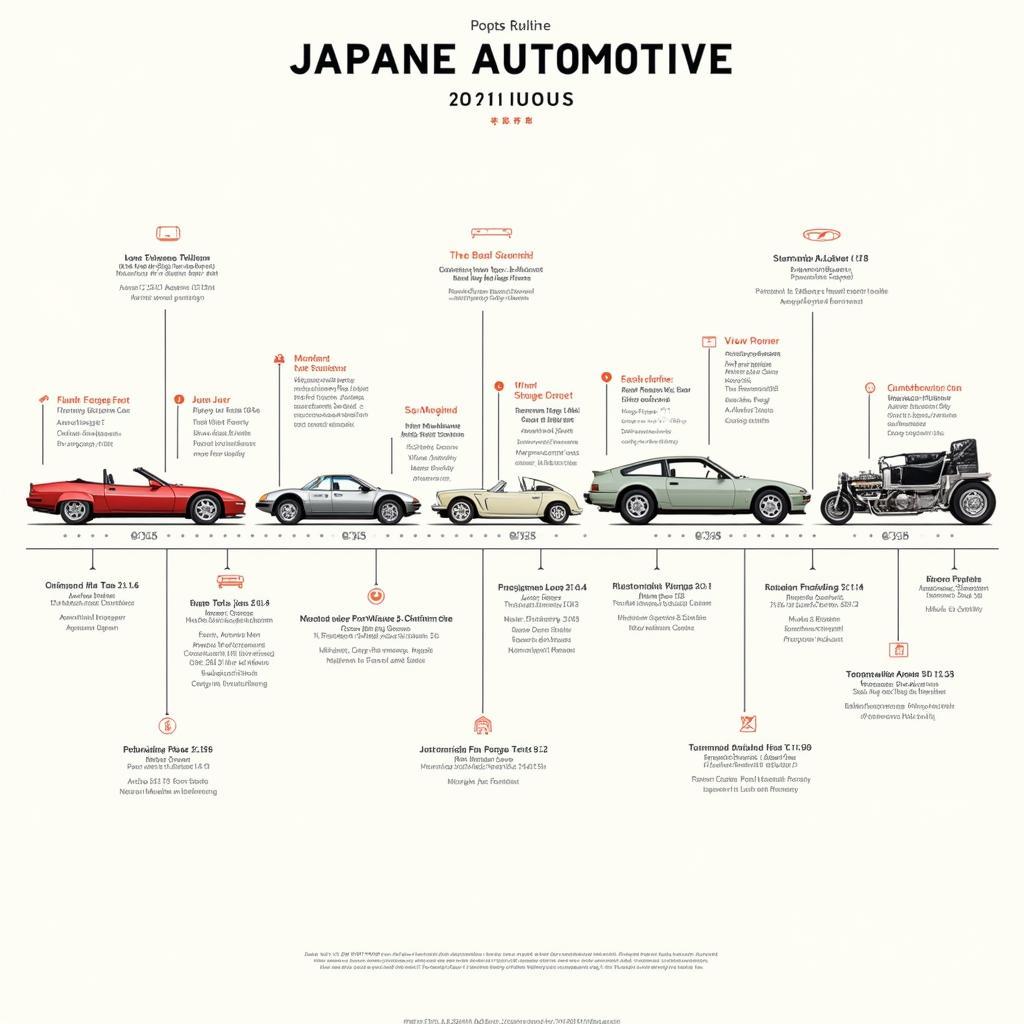
Japan’s automotive industry has risen from humble beginnings to dominate the global market. This article explores its remarkable journey, from its early days to its current achievements.
From Humble Beginnings to Golden Age: The Evolution of Japan’s Car Industry
Japan’s automotive industry began in the early 20th century, assembling cars based on foreign models. Slow initial growth, interrupted by World War II, laid the foundation for a later boom. The 1950s and 1960s saw the rise of brands like Toyota, Nissan, and Honda, focusing on small, fuel-efficient cars for domestic and international markets.
History of the Japanese automotive industry
Keys to Success: Driving Forces Behind Japan’s Automotive Dominance
The success of Japan’s automotive industry rests on several pillars: technological innovation, the Kaizen philosophy (continuous improvement), and strong collaboration between manufacturers, suppliers, and the government. Japanese automakers pioneered advanced manufacturing techniques like the Toyota Production System (TPS), maximizing efficiency and minimizing waste. The Kaizen spirit permeates every stage of production, fostering constant innovation and improvement.
Pioneering Technology: Innovation and Ingenuity in Japanese Car Manufacturing
Japan’s automotive industry consistently leads in research and development. From hybrids to electric vehicles, Japanese automakers invest heavily in sustainable mobility solutions. A focus on quality, reliability, and fuel efficiency has earned Japanese cars global consumer trust.
Similar to the automotive mechanics industry, Japan’s car manufacturing demands deep technical and technological understanding. The blend of tradition and modernity, engineering and artistry, defines the unique character of the Japanese automotive industry.
Challenges and Opportunities: The Future of Japan’s Automotive Industry
Facing intensifying global competition, Japan’s automotive industry confronts new challenges, including the rise of Chinese and South Korean automakers and the shift towards electric and autonomous vehicles. However, with a solid foundation and a spirit of relentless innovation, it retains significant opportunities for continued growth and leadership.
Learn more about the car assembly industry for a deeper understanding of vehicle production.
Conclusion
Japan’s automotive industry has traversed a long and challenging path to achieve its current status. The combination of technological innovation, the Kaizen spirit, and strategic vision has propelled it to become a global leader. The future holds both promise and challenges, with ample opportunities for continued growth. To learn more about popular car brands in Vietnam, read our article on best-selling car brands in Vietnam.
FAQ
- Why is the Japanese auto industry so successful?
- Which Japanese car brands are most famous?
- What technologies are being used in Japanese car manufacturing?
- What is the biggest challenge facing the Japanese auto industry?
- What is the future of the Japanese auto industry?
- What role does the Japanese government play in supporting the auto industry?
- How can I learn more about the history of the Japanese auto industry?
You can learn more about car cooling systems and why Vietnam doesn’t produce cars.
For assistance, please contact us: Phone: 0968239999, Email: [email protected] or visit us at: TT36 – CN9 Road, Tu Liem Industrial Zone, Phuong Canh Ward, Nam Tu Liem District, Hanoi. We have a 24/7 customer service team.









