
“Better safe than sorry” – This old adage holds especially true when it comes to driving. Besides obeying traffic laws, maintaining a safe following distance is crucial for avoiding frustrating situations and, more importantly, preventing accidents. So, what’s the safe following distance? How can you accurately estimate it? Let’s delve into the details with Hanoi Truck!
The Importance of Maintaining a Safe Following Distance
Have you ever wondered why a seemingly simple “empty space” carries such significance?
Psychological Perspective:
A safe following distance allows drivers to feel more comfortable and confident behind the wheel, reducing stress and pressure, especially in heavy traffic.
Expert Opinion:
Robert Johnson, a traffic safety expert at the American Institute for Traffic Safety Research, states: “Maintaining a safe following distance is a key factor in reducing traffic accidents. This distance provides drivers with sufficient time and space to react promptly to unexpected situations.” – excerpt from “Traffic Safety – From Awareness to Action”.
Technical Aspect:
The safe following distance acts as a protective “buffer zone.” If the vehicle in front brakes suddenly or encounters a problem, this distance allows you to react appropriately: braking, steering to avoid collision… without hitting the vehicle ahead.
Cars maintaining a safe following distance
What is the Minimum Safe Following Distance?
According to the Vietnam Road Traffic Law:
- Urban Areas: The maximum speed limit is 50km/h, and the minimum safe following distance is 10m.
- Outside Urban Areas: Depending on the speed, the minimum safe following distance is regulated as follows:
- Speed from 30 – 50km/h: Minimum distance is 20m.
- Speed from 50 – 80km/h: Minimum distance is 50m.
- Speed above 80km/h: Minimum distance is 70m.
How to Estimate Safe Following Distance:
In addition to adhering to regulations, you can apply the “2-second rule” to estimate a safe following distance:
- Choose a fixed point on the road (a utility pole, a road sign…).
- When the vehicle in front passes the fixed point, start counting “one thousand one, one thousand two…”.
- If your vehicle passes the same point before you finish counting “one thousand two,” you’re too close and need to increase the distance.
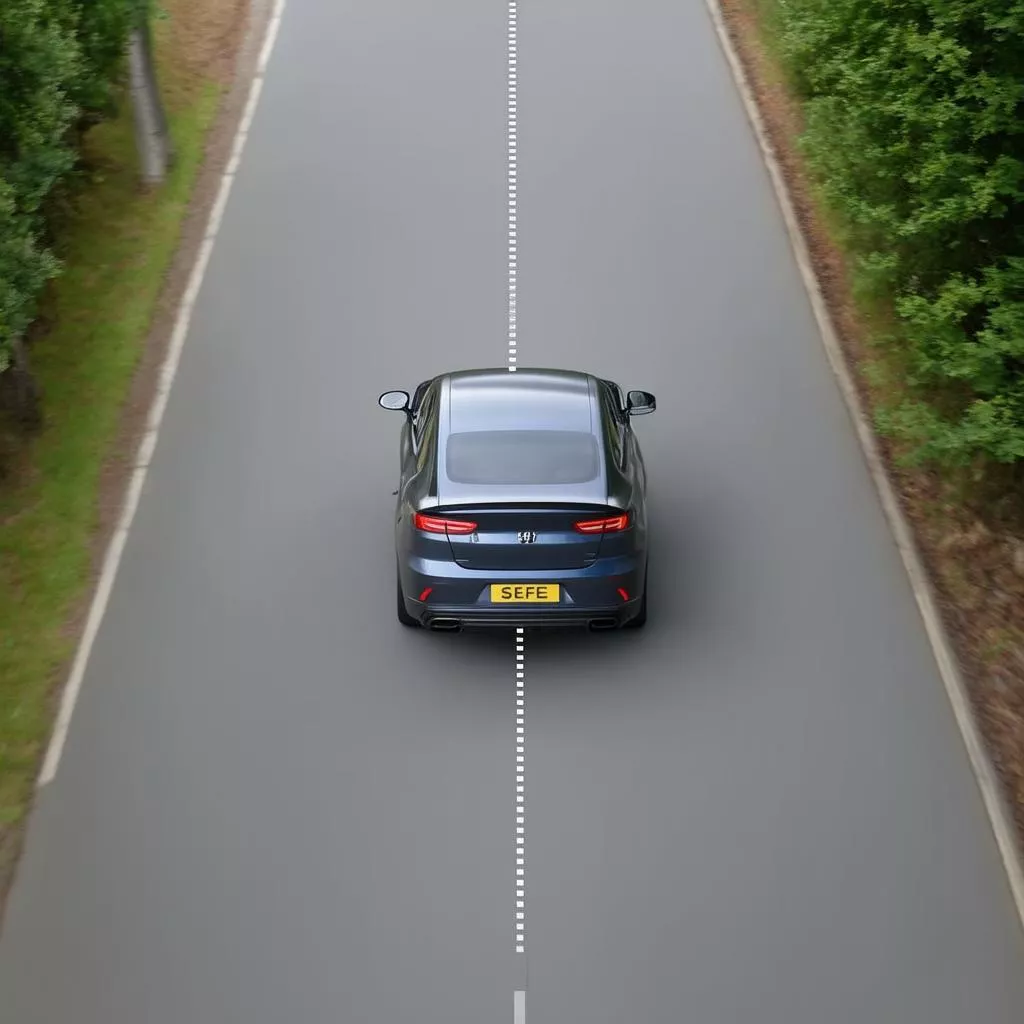 Driver estimating safe following distance using the 2-second rule
Common Situations and How to Handle Them
1. Tailgating:
- Solution: Maintain your speed and safe following distance. If necessary, gradually reduce your speed to allow the tailgating vehicle to overtake. Never brake suddenly or swerve abruptly.
- Superstition: Tailgating might indicate you’re “blocking their fortune.” To remedy this, you could yield and let them pass or silently recite a protective prayer.
2. Slow-Moving Vehicle Ahead:
- Solution: Carefully observe traffic conditions, signal your intention to overtake, and pass only when it’s safe to do so.
- Superstition: Encountering slow-moving vehicles might symbolize obstacles in your work. Remain calm and patient; things will eventually smooth out.
3. Driving in Bad Weather:
- Solution: Double your safe following distance, reduce speed, turn on your headlights, and maintain utmost concentration.
- Superstition: Bad weather often brings misfortune. Exercise extra caution when driving in rain, wind, or fog to avoid bad luck.
Frequently Asked Questions
1. Does the minimum safe following distance change when it rains?
Answer: Yes. When it rains, roads become slippery, and visibility is reduced. You should double the safe following distance compared to normal conditions.
2. How to judge a safe following distance when driving a truck?
Answer: With trucks, due to their heavier weight and greater inertia, the safe following distance needs to be increased compared to cars. You can refer to the article on 3-ton beam bridge design for a better understanding of truck load and inertia.
Conclusion
The minimum safe following distance is not just a legal requirement but a crucial element for your safety and the safety of others on the road. Always remember and adhere to safe following distance regulations, and apply the tips shared here to drive safely on every journey.
For more informative articles about trucks, please visit xetaihanoi.edu.vn, such as articles on car lift dimensions or specifications of a 3-ton manual chain hoist.
Be a wise driver, prioritize safety!
For any questions or assistance regarding trucks, contact HANOI TRUCK Dealership or Hotline: 0968 239 999. We are available 24/7 to assist you.









