The automotive differential is a crucial component in a vehicle’s drivetrain, responsible for distributing engine power to the two drive wheels. It allows the wheels to rotate at different speeds when cornering, ensuring stability and safety. This article provides a detailed understanding of the differential, its components, working principles, and significance for trucks and other vehicles.
Components of an Automotive Differential
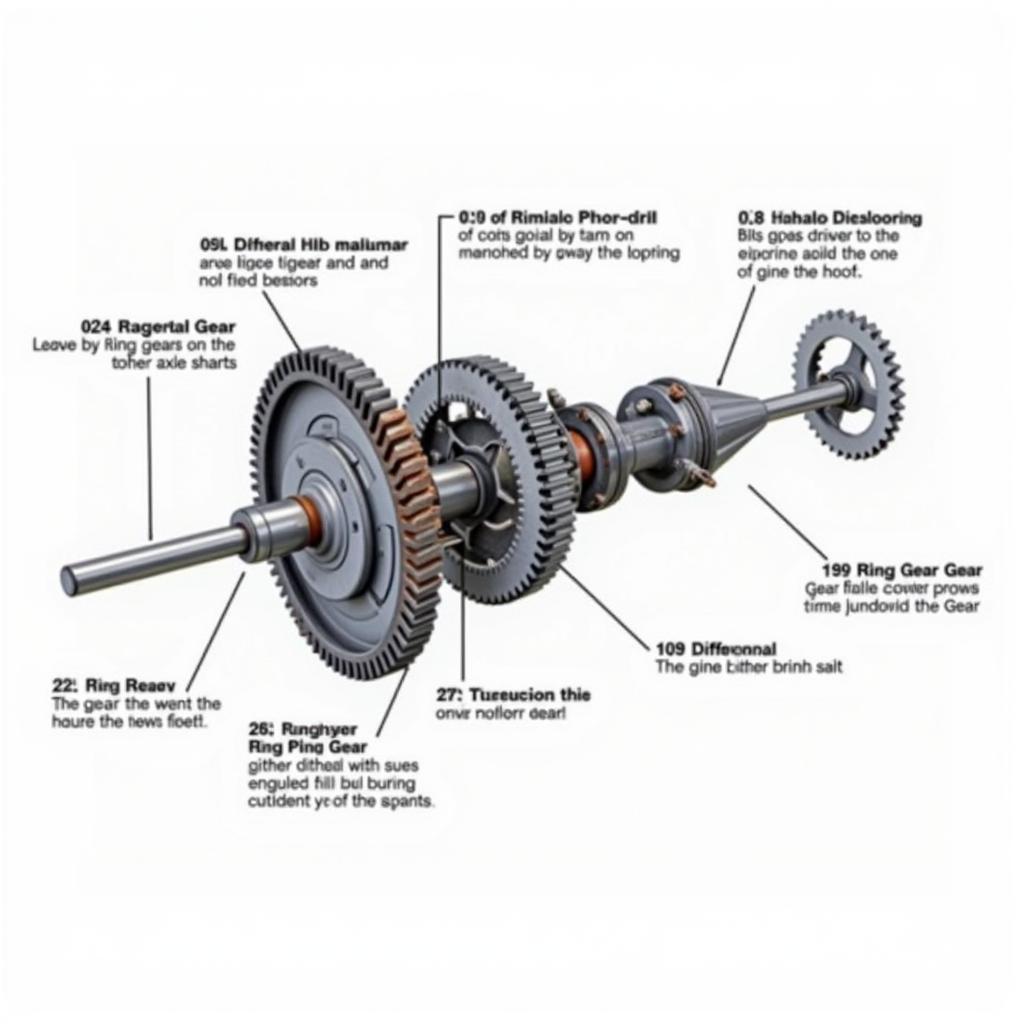
The automotive differential consists of several complex parts working in harmony. Key components include planetary gears, axle gears, the differential casing, and a differential lock (optional). Planetary gears, located in the center, receive power from the propeller shaft and distribute it to the two axle gears. Axle gears connect to the wheel axles, transmitting power to the wheels. The differential casing houses lubricating oil, protecting internal components from friction and wear.
Diagram of an automotive differential
How the Differential Works
When a vehicle travels straight, both wheels rotate at the same speed. The planetary gears rotate only on their axis and not around the axle gears. Power is distributed evenly to both wheels. When cornering, the outer wheel must rotate faster than the inner wheel for smooth movement. In this case, the planetary gears rotate both on their axis and around the axle gears, allowing the outer wheel to spin faster. This ensures stable cornering and prevents wheel slippage.
The Importance of the Differential
The differential plays a vital role in ensuring vehicle safety and performance. Without a differential, turning would be difficult, leading to slippage, loss of control, and potential accidents, especially for heavy trucks. For trucks, the differential also ensures even power distribution to the wheels, enhancing off-road capabilities. Regular differential maintenance is crucial for extending its lifespan and ensuring vehicle stability.
Types of Automotive Differentials
Various types of differentials exist, each with its advantages and disadvantages. Common types include open differentials, limited-slip differentials, and locking differentials. Choosing the right type depends on the vehicle type and operating conditions.
Conclusion
The automotive differential is a critical component, ensuring safe and efficient vehicle operation. Understanding its structure, working principles, and importance allows for better vehicle operation and maintenance.
FAQ
- What is the purpose of a differential? The differential allows the two drive wheels to rotate at different speeds when turning.
- When should differential oil be changed? Differential oil should be changed according to the manufacturer’s recommended intervals.
- What are the signs of a faulty differential? Unusual noises when turning and vehicle vibration indicate potential differential problems.
- Should locking differentials be used for trucks? Using locking differentials for trucks requires careful consideration based on operating conditions.
- How is a differential maintained? Differential maintenance includes oil changes and inspecting for worn or damaged parts.
- Does the differential affect fuel consumption? A malfunctioning differential can increase fuel consumption.
- How do I choose the right type of differential? Choosing the right differential depends on the vehicle type and operating conditions.
For assistance, please contact us by phone at 0968239999, email at [email protected], or visit our address: TT36 – CN9 Road, Tu Liem Industrial Park, Phuong Canh Ward, Nam Tu Liem District, Hanoi. We have a 24/7 customer service team.









