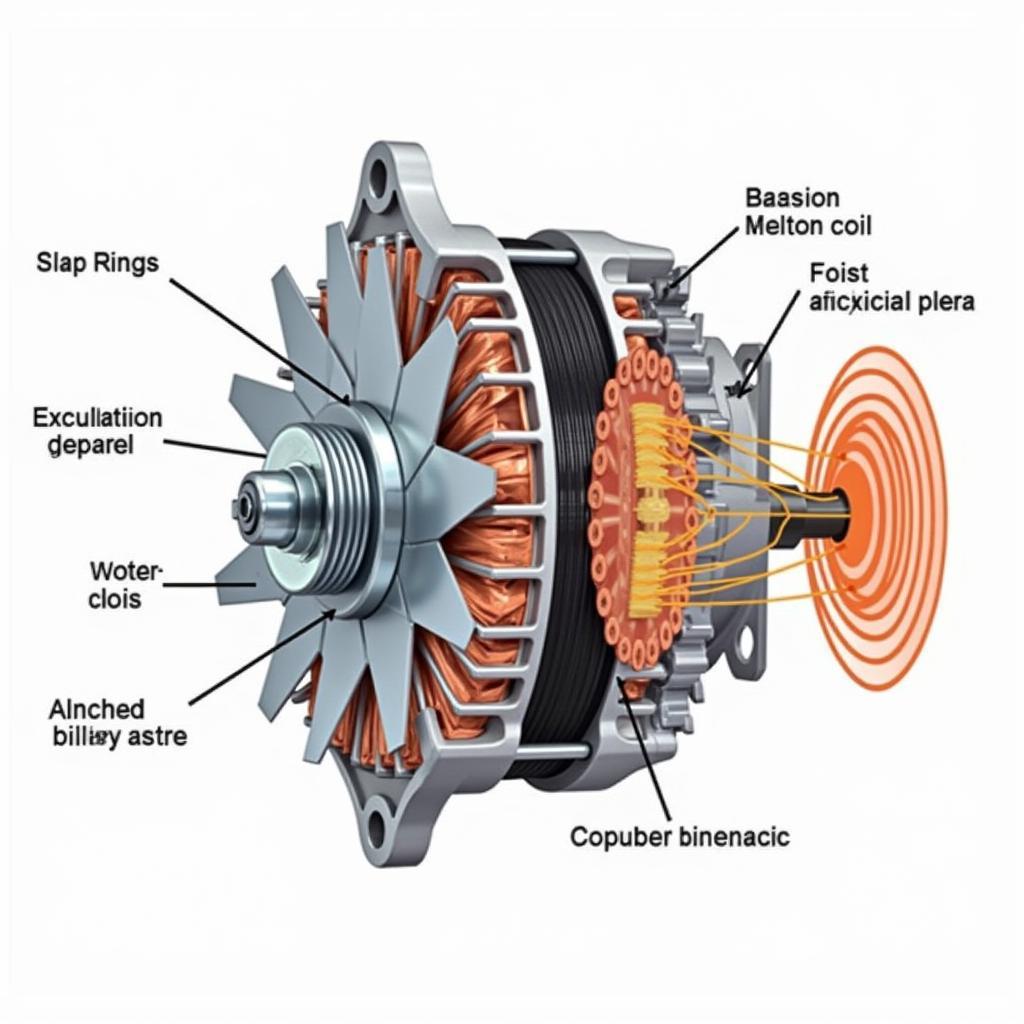
An alternator is a crucial component in a vehicle, responsible for powering the entire electrical system when the engine is running. Understanding its structure enables effective maintenance and troubleshooting.
This article provides a detailed breakdown of a car alternator’s components and operating principles. We’ll explore the key parts and how to identify signs of malfunction. Interested in learning how an alternator works? Check out our article on how a car alternator works.
Rotor: The Heart of the Alternator
The rotor is the rotating component within the alternator, tasked with generating a rotating magnetic field. It consists of a rotor shaft, field windings, and slip rings. Electricity flowing through the field windings creates the magnetic field.
The rotor is essential to an alternator’s function, generating the electrical power source. Its stable operation directly impacts the entire vehicle’s electrical system performance.
Car alternator rotor components
Stator: Where Electricity is Generated
The stator is the stationary component surrounding the rotor. It comprises a core made of electrical steel and stator windings evenly distributed within its slots. As the rotor’s magnetic field rotates, it sweeps across these windings, inducing an alternating current (AC).
The stator is where electricity is generated, an integral part of the alternator. It operates on the principle of electromagnetic induction, converting the rotating magnetic field into electrical current. Having electrical issues? Refer to our article on car alternator wiring diagrams.
Rectifier: Converting AC to DC
The AC generated in the stator needs conversion to direct current (DC) to power the vehicle’s electrical systems. The rectifier, typically made of semiconductor diodes, performs this function.
The rectifier bridges the gap between the alternator and the vehicle’s electrical system. A malfunctioning rectifier leads to unstable current, impacting electrical component performance. Need alternator repairs? See our article on car alternator repair.
Other Components
Besides the three main components, a car alternator includes other parts like the housing, bearings, pulley, and voltage regulator. Each part plays a crucial role in ensuring the alternator’s stable operation. Have young children? A Fisher-Price car seat is a safe choice for your child.
 Other car alternator components
Conclusion
Understanding a car alternator’s structure is crucial for maintenance and troubleshooting electrical issues. From the rotor and stator to the rectifier and other components, each contributes to providing a stable power source for the vehicle. Looking for information about learning to drive? Check out our article on tips for new drivers.
FAQ
- What is the function of a car alternator?
- What are the rotor and stator?
- What is the role of the rectifier?
- How can I tell if my alternator is bad?
- When should I replace my alternator?
- What are the other components of an alternator?
- How do I maintain my alternator?
For assistance, please contact us at Phone: 0968239999, Email: [email protected] or visit us at: TT36 – CN9 Road, Tu Liem Industrial Zone, Phuong Canh Ward, Nam Tu Liem District, Hanoi. We have a 24/7 customer support team.









