“All under heaven is one family” – this ancient proverb reflects the seemingly broad worldview of ancient China regarding its relations with other nations. But what was China’s foreign policy truly like during the feudal era? Were they benevolent brothers or a “hidden dragon” waiting to pounce? Let’s delve into this fascinating topic with Xe Tải Hà Nội.
1. From “Celestial Empire” to Isolationism
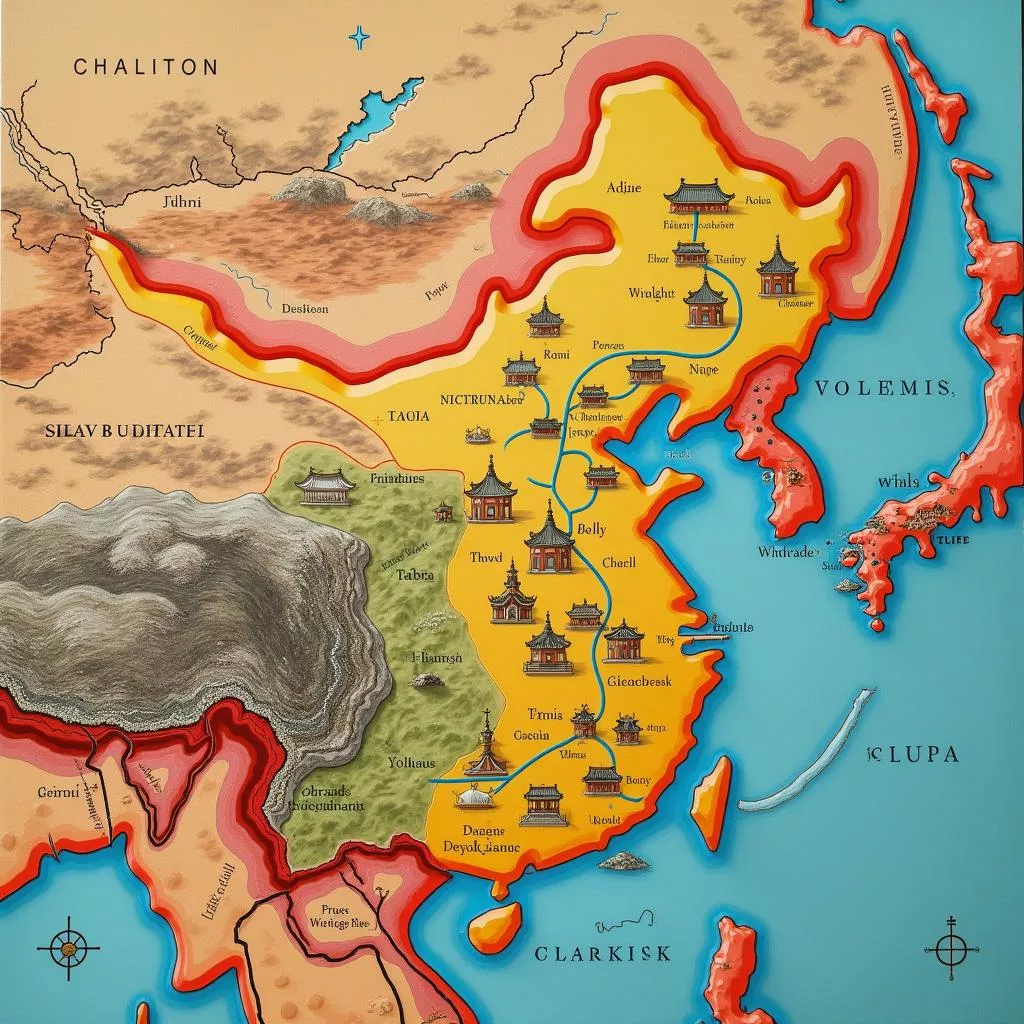
Ancient Chinese Foreign Policy Map
Feudal China considered itself the center of the world, the “Celestial Empire,” possessing a culture far superior to all others. This worldview led to a foreign policy emphasizing “emphasizing culture over military might,” prioritizing tributary relationships over territorial expansion. As long as other nations submitted and paid tribute, military conquest was deemed secondary.
However, this doesn’t mean China was complacent. History witnessed numerous wars initiated by Chinese dynasties to protect their “authority,” such as the Ming dynasty’s invasion of Vietnam in the early 15th century.
By the Ming and Qing dynasties, China adopted a policy of isolationism, restricting trade with the West. This was largely due to growing anxieties over the increasing power of European nations.
Professor Nguyen Van A, a specialist in Chinese history at the University of Social Sciences and Humanities in Hanoi, states: “The isolationist policy was a strategic mistake for China. It led to the country falling behind the West in terms of economy and science and technology, creating conditions for Western powers to invade and turn China into a ‘prey’ in the 19th century.” (Excerpt from “History of China,” National University of Hanoi Publishing House, 2022)
2. “Soft Power” – A Double-Edged Sword
 Chinese Cultural Influence in East Asia
Beyond military strength, feudal China also emphasized “soft power” to influence neighboring countries. Confucianism, the dominant ideology, spread significantly to neighboring countries like Vietnam, Korea, and Japan.
However, “soft power” could be a double-edged sword. The rigid imposition of culture and ideology often led to conflicts and resentment.
3. Lessons from the Past
China’s foreign policy in the feudal era is a broad, complex topic with diverse interpretations. Studying it provides a deeper understanding of Chinese history and culture, offering valuable lessons for Vietnam’s foreign policy in the modern context.
If you’re interested in learning more about truck, dump truck, pickup truck, or other vehicle prices, visit https://xetaihanoi.edu.vn/. We offer a wide range of information on various trucks to meet your needs.
Contact Xe Tải Hà Nội for free consultation and attractive offers:
- Phone: 0968239999
- Email: [email protected]
- Address: No. TT36 – CN9 Road, Tu Liem Industrial Park, Phuong Canh Ward, Nam Tu Liem District, Hanoi.
Xe Tải Hà Nội – Your companion on every road!









