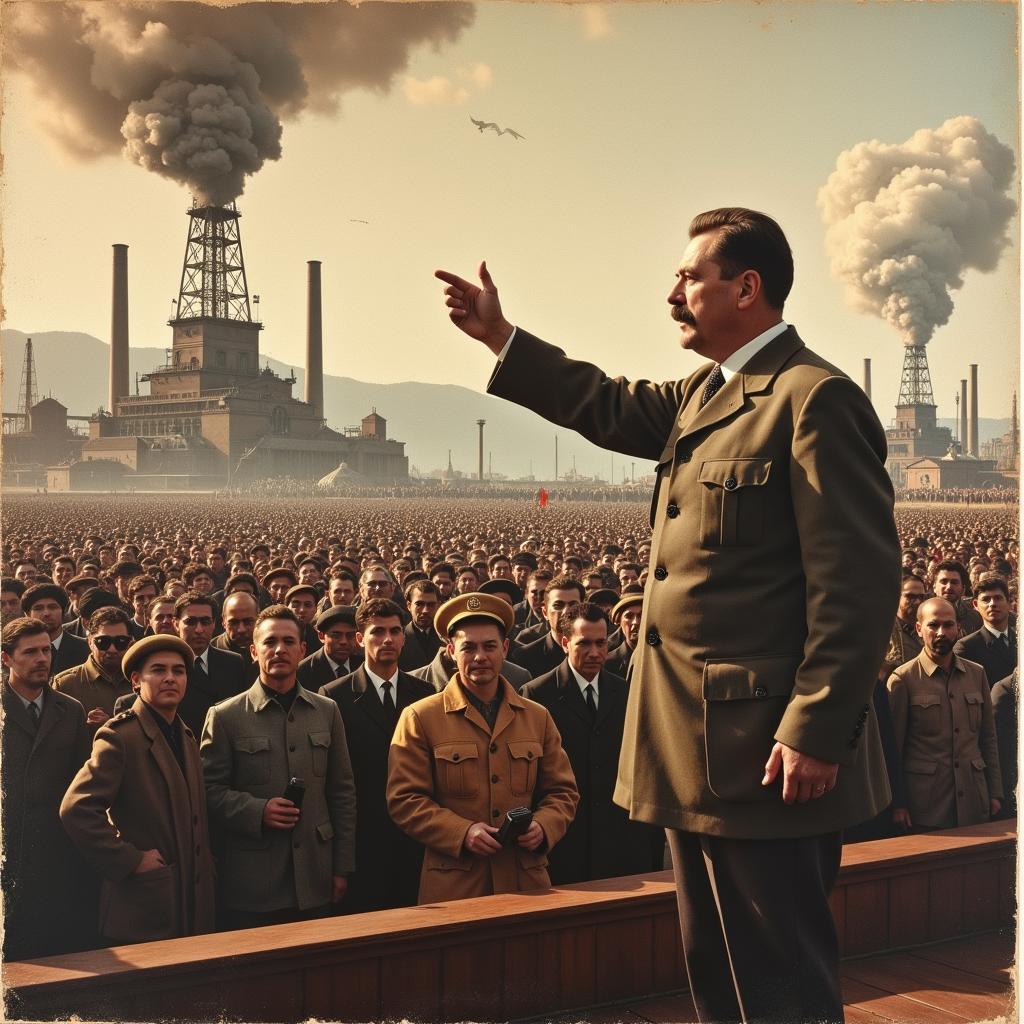
The New Economic Policy (NEP) was an economic policy implemented in the Soviet Union from 1921 to 1928. The NEP replaced War Communism with a mixed economic system, allowing some aspects of capitalism to exist under state control. This article will delve into the details of the NEP, its origins, content, and impact.
Origins of the New Economic Policy (NEP)
Following the Russian Civil War (1917-1922), the Soviet economy was devastated. War Communism, with its focus on heavy industry and grain requisitioning, led to famine, decreased agricultural production, and social unrest. Lenin recognized the need for change to revive the economy and consolidate Bolshevik power. The NEP emerged in this context as a temporary solution to address the economic and social crisis.
Content of the New Economic Policy (NEP)
The NEP encompassed a series of economic reforms. Firstly, grain requisitioning was replaced by a tax in kind. Peasants were allowed to sell surplus produce on the free market after paying the tax. Secondly, small and medium-sized enterprises were privatized, while the state retained control of key industries such as banking, foreign trade, and heavy industry. Thirdly, the NEP encouraged foreign investment and the development of trade.
Impact of the NEP on the Soviet Economy
The NEP had a positive impact on the Soviet economy. Agricultural production increased, famine was alleviated, and the market for goods became vibrant. Private enterprises flourished, creating jobs and contributing to the state budget. However, the NEP also created social inequalities, with the emergence of a new capitalist class (NEPmen).
The NEP and the Development of the Soviet Union
The NEP is considered a strategic retreat from communism to strengthen the economy. Although successful in reviving the economy, it also created conflicts within the Bolshevik Party. Some viewed the NEP as a betrayal of communist ideals, while others considered it necessary for survival. Ultimately, the NEP was abolished by Stalin in 1928, replaced by the policies of agricultural collectivization and forced industrialization.
Stalin abolishing the NEP and implementing collectivization
Conclusion
The New Economic Policy was a significant period in Soviet history. It demonstrated Lenin’s flexibility in adjusting economic policies to fit reality. Although short-lived, the NEP provided valuable lessons about the role of the market in a centrally planned economy. This article has provided a detailed explanation of the NEP. To learn more about the effects of the new economic policy in Russia, please see the related article.
FAQ
- What does NEP stand for? NEP stands for “New Economic Policy.”
- Who initiated the NEP? The NEP was initiated by Vladimir Lenin.
- What was the main goal of the NEP? The main goal of the NEP was to revive the Soviet economy after the civil war and famine.
- When was the NEP implemented and when did it end? The NEP was implemented from 1921 to 1928.
- Why was the NEP abolished? The NEP was abolished by Stalin, who wanted to replace it with the policies of agricultural collectivization and forced industrialization.
- How did the NEP impact farmers? The NEP allowed farmers to sell surplus produce on the free market after paying a tax, improving their living standards.
- What was the NEP’s influence on the industrial development of the Soviet Union? The NEP allowed for the development of small and medium-sized private enterprises, contributing to economic recovery. You can learn more about state cultural policies for a broader overview.
For assistance, please contact us by phone: 0968239999, Email: [email protected] or visit us at: TT36 – CN9 Road, Tu Liem Industrial Park, Phuong Canh Ward, Nam Tu Liem District, Hanoi. We have a 24/7 customer support team. To learn more about policies from 2001 to the present, you can refer here. Learn more about gender equality policy dissertation for a better understanding of other social policies.









