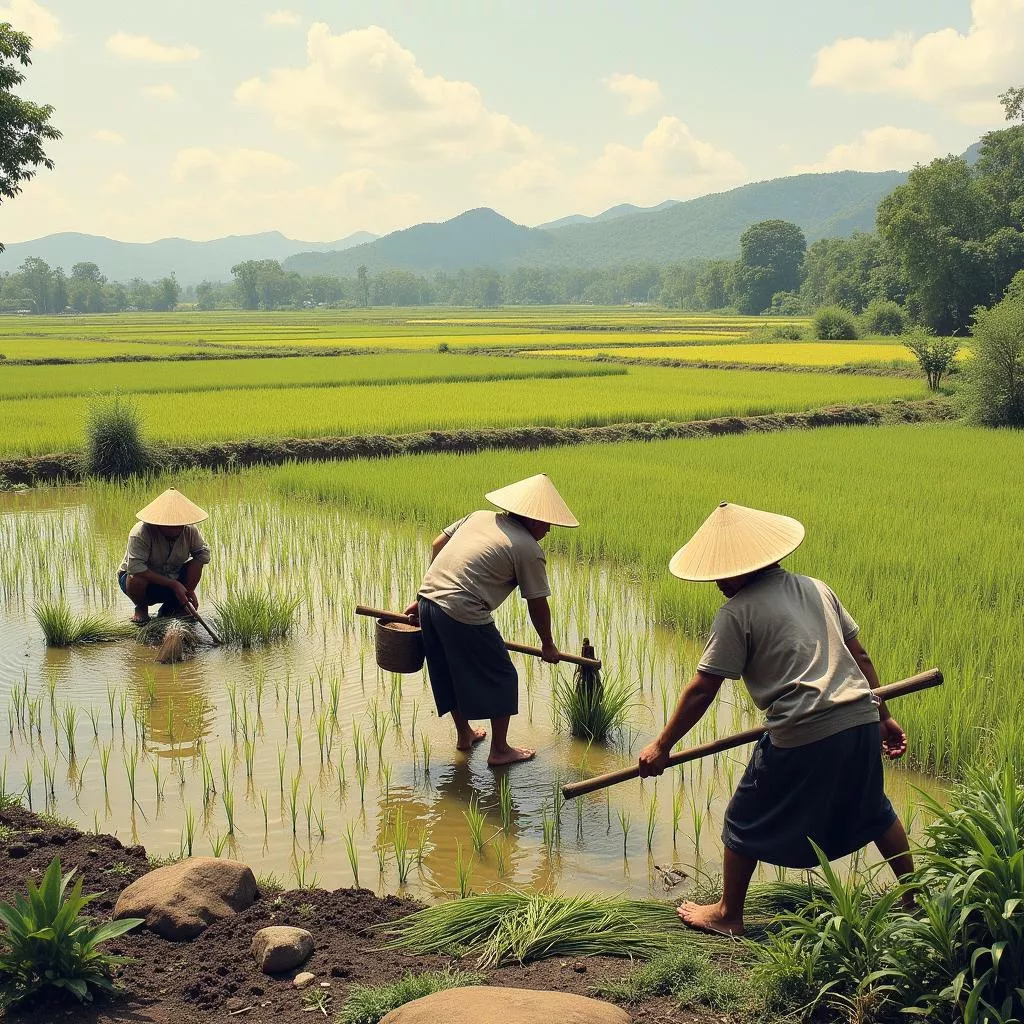
The Vietnamese proverb “Sell distant relatives, buy close neighbors” is familiar to every Vietnamese person. But did you know that to acquire land, our ancestors went through many ups and downs with the Quan Dien land policy? So, what was the Quan Dien land policy? Let’s explore with XE TẢI HÀ NỘI!
What Was the Quan Dien Land Policy? Concept and History
The Quan Dien land policy was a land allocation system for soldiers enacted and managed by the state. Originating in feudal China, this policy was implemented in Vietnam from the period of Chinese domination until the Nguyen Dynasty.
Depiction of the Quan Dien land policy during the feudal period
The initial objectives of this policy were:
- Military Buildup: Attract citizens to join the army by promising land grants after completing their service.
- Land Reclamation: Convert wasteland and uncultivated land into arable land, increasing agricultural land area.
- Social Stability: Provide employment for soldiers after demobilization, limiting the plight of wandering farmers.
Implementation of the Quan Dien Land Policy in Vietnam Through Different Periods
From the Dinh, Tien Le dynasties to the Ly, Tran, Le, and Nguyen dynasties, the Quan Dien land policy underwent numerous changes to adapt to each historical context and social situation:
- Early Period: The Quan Dien policy was implemented quite thoroughly, contributing significantly to strengthening national defense and developing agriculture.
- Later Period: Due to the influence of various factors, especially the greed of the ruling class, the Quan Dien policy gradually revealed many shortcomings. Land fell into the hands of landlords and powerful figures, leaving farmers impoverished and landless.
It can be seen that the Quan Dien land policy was once a progressive policy, playing a crucial role in the construction and development of the country. However, due to many objective and subjective factors, this policy became unsuitable and gradually faded over time.
The Quan Dien Land Policy and the Story of Farmers in Ancient Times
To better understand the Quan Dien land policy, let’s revisit the story of Mr. Ba – a kind farmer who lived during the Tran Dynasty. Mr. Ba had an only son, Tu, who was strong, gentle, and skilled in farming.
 Tu in the army
One day, the army came to the village to recruit young men. Tu, wanting to acquire land to provide for his family, volunteered to join the army. After years of fighting, Tu achieved many glorious feats and was rewarded with land by the king under the Quan Dien policy. Thanks to this, Mr. Ba’s family went from being poor to having a more prosperous life.
However, not everyone was as fortunate as Tu. Many soldiers, after demobilization, did not receive land or received very little, falling back into poverty and hardship. The Quan Dien policy thus gradually became a lucrative opportunity for the greedy ruling class, causing further suffering for the farmers.
Lessons from the Quan Dien Land Policy for Today’s Development
Although the Quan Dien land policy has become a story of the past, the lesson about fair and reasonable land management and distribution remains relevant today. Ensuring land rights for farmers and providing them with access to production resources are crucial factors for developing agriculture and rural areas, and building a fair, democratic, and civilized society.
Want to learn more about other state policies? Refer to the article on state policies on seafood business.
For detailed advice on trucks suitable for your transportation needs, please contact:
Phone Number: 0968239999
Email: [email protected]
Address: No. TT36 – CN9 Road, Tu Liem Industrial Park, Phuong Canh Ward, Nam Tu Liem District, Hanoi.