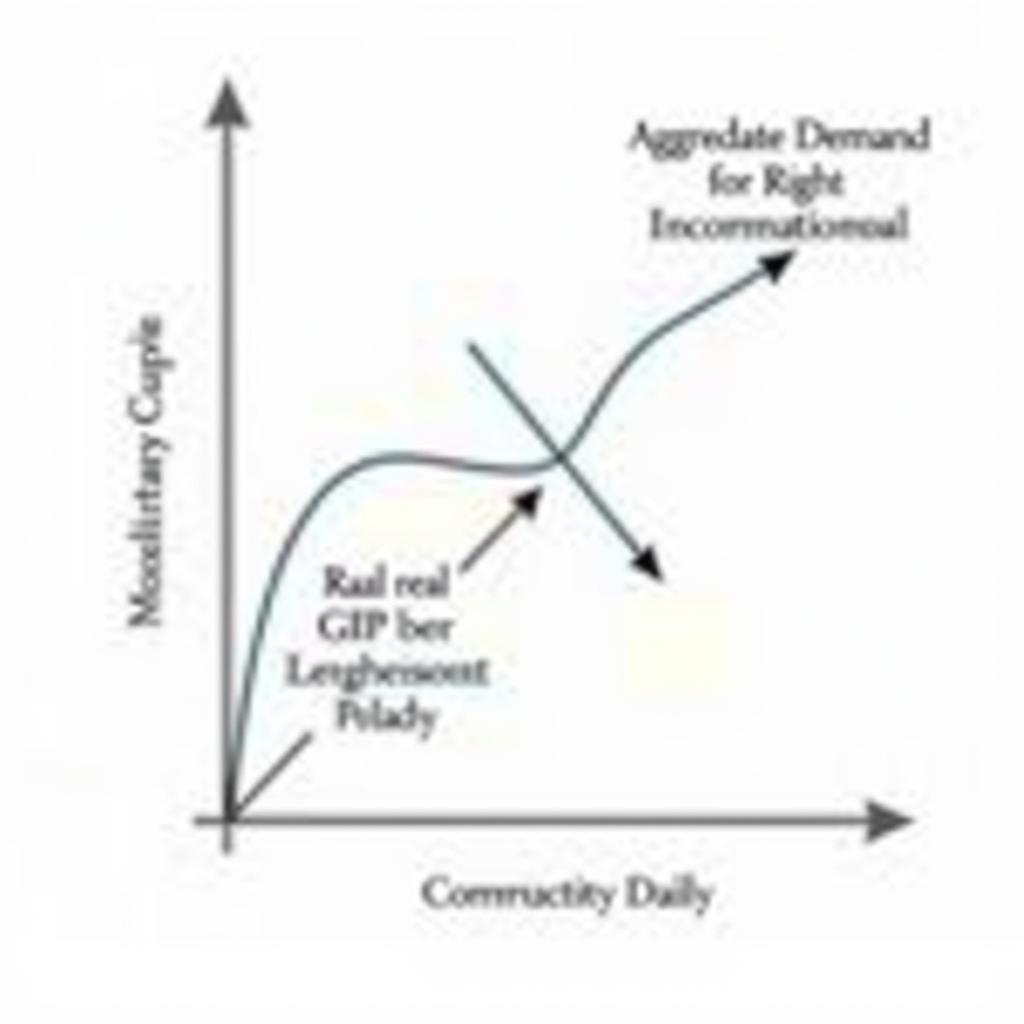
Monetary policy and aggregate demand are closely intertwined, directly impacting economic stability and growth. Monetary policy, through adjustments to money supply, interest rates, and exchange rates, influences spending by various economic actors, thereby affecting aggregate demand.
The Relationship Between Monetary Policy and the Aggregate Demand Curve
Expansionary monetary policy, such as lowering interest rates, makes borrowing easier, encouraging businesses to invest and consumers to spend more. This increases aggregate demand, shifting the aggregate demand curve to the right. Conversely, contractionary monetary policy, such as raising interest rates, reduces investment and consumption, causing aggregate demand to fall and the aggregate demand curve to shift to the left. Immediately following this introduction, let’s learn about policymakers.
How Monetary Policy Affects Components of Aggregate Demand
Monetary policy influences aggregate demand by impacting its main components: consumption (C), investment (I), government spending (G), and net exports (NX). Low interest rates encourage consumption and investment, while high interest rates have the opposite effect.
Impact of Monetary Policy on Aggregate Demand
For example, when the State Bank reduces interest rates, borrowing costs decrease, encouraging businesses to invest in expanding production. Simultaneously, consumers have easier access to credit, promoting spending on goods and services.
Factors Influencing the Effectiveness of Monetary Policy
The effectiveness of monetary policy depends on various factors, including the economy’s sensitivity to interest rates, inflation expectations, the global economic situation, and the credibility of the central bank. During periods of economic instability, monetary policy may be less effective. You can learn more about the fundamentals of monetary policy.
Monetary Policy in the Short Run and Long Run
The impact of monetary policy on aggregate demand differs in the short run and the long run. In the short run, monetary policy can stimulate economic growth by increasing aggregate demand. However, in the long run, the primary impact of monetary policy is on the general price level, not real output. A prime example is Vietnam’s fiscal policy in 2016.
Expert Nguyen Van A, Director of the Institute of Economic Research, stated: “Monetary policy needs to be adjusted flexibly, in accordance with each stage of economic development, to achieve the goal of macroeconomic stability.”
The Government’s Role in Regulating Aggregate Demand
The government also plays a crucial role in regulating aggregate demand through fiscal policy. Coordination between monetary and fiscal policies is essential to achieve macroeconomic stability. Learn more about the government budget formula to better understand the government’s role.
Conclusion
Monetary policy and aggregate demand are closely related, significantly impacting the economy. Understanding this relationship helps policymakers make sound decisions, contributing to stable and sustainable economic development. The General Department of Taxation’s policies also play a crucial role in this.
FAQ
- What is monetary policy?
- What is aggregate demand?
- What is the relationship between monetary policy and aggregate demand?
- How does monetary policy affect inflation?
- What is the role of the central bank in managing monetary policy?
- How does fiscal policy affect aggregate demand?
- How can monetary and fiscal policies be coordinated effectively?
For assistance, please contact us by phone: 0968239999, Email: [email protected] Or visit us at: TT36 – CN9 Road, Tu Liem Industrial Park, Phuong Canh Ward, Nam Tu Liem District, Hanoi. We have a 24/7 customer service team.









