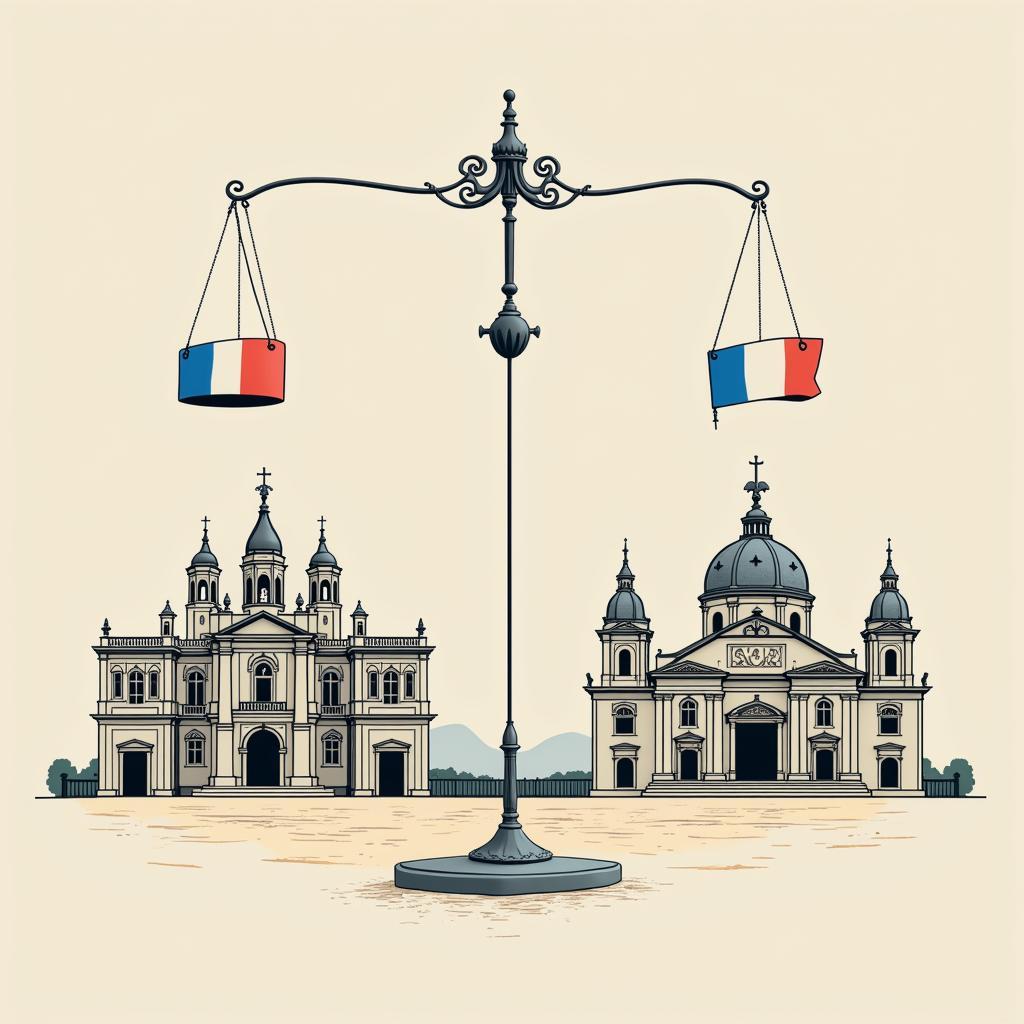
France’s religious policy, often defined by the term laïcité (secularism), is a complex and frequently debated topic. Its core principle is the separation of church and state, guaranteeing freedom of religion for all citizens while maintaining the state’s neutrality in religious matters.
Laïcité in French Religious Policy
Laïcité goes beyond the simple separation of church and state. It encompasses ensuring freedom of conscience and the freedom to practice one’s religion for all citizens while preventing religious influence in public affairs. This differs from secular models in other countries, where the state may recognize or support certain religions. This policy is considered a cornerstone of the French Republic and is enshrined in the Constitution.
French religious policy and the concept of Laïcité
The Evolution of Religious Policy in France
The history of laïcité in France spans centuries, from the French Revolution of 1789 to modern debates about religious expression in public spaces. The 1905 law on the Separation of Churches and State is considered a landmark achievement, formally establishing the principle of laïcité in French law. However, the practical application of laïcité continues to be a challenge, especially in the context of France’s increasingly diverse religious and cultural landscape.
Religious Policy and the Rule of Law in France
Debates Surrounding Laïcité
France’s laïcité policy is not without controversy, particularly regarding the wearing of religious symbols in public. The 2004 law prohibiting the wearing of “conspicuous” religious symbols in public schools sparked considerable debate. Some argue that the law is necessary to protect the secular nature of the state and equality among students. Others contend that it infringes upon religious freedom and discriminates against certain religious groups.
The Future of Laïcité
In the context of globalization and migration, France’s laïcité policy continues to face new challenges. How to balance religious freedom with the secularity of the state remains an open question. Finding this balance is essential to ensure social harmony and respect for the rights of all citizens.
What are Environmental Law and Policy?
The Impact of French Religious Policy on Society
France’s religious policy, with its principle of laïcité, has a profound impact on French society, from education to public life. It shapes how the state interacts with religious groups and influences the daily lives of its citizens. Understanding this policy is key to understanding contemporary French society.
Conclusion
France’s religious policy, based on the principle of laïcité, is a complex and evolving subject. The ongoing search for a balance between religious freedom and state neutrality is a constant challenge, requiring dialogue and understanding.
 The future of religious policy in France
Chemical Poison Policy in Thai Binh Province
FAQ
- What is Laïcité?
- Laïcité is the principle of separation of church and state, guaranteeing freedom of religion and state neutrality.
- What is the significance of the 1905 law?
- This law formally established the principle of laïcité in French law.
- Why is France’s religious policy controversial?
- It’s controversial due to issues surrounding religious expression in public spaces.
- What does the 2004 law stipulate?
- This law prohibits the wearing of “conspicuous” religious symbols in public schools.
- What is the future of laïcité?
- Its future depends on finding a balance between religious freedom and secularism.
- How does laïcité affect French society?
- It profoundly impacts education, public life, and how the state interacts with religion.
- Where can I learn more about this topic?
- You can learn more through academic resources and analytical articles.
Religious Policy of the Communist Party of Vietnam
For assistance, please contact us by phone: 0968239999, Email: [email protected] or visit our address: No. TT36 – CN9 Road, Tu Liem Industrial Zone, Phuong Canh Ward, Nam Tu Liem District, Hanoi. We have a 24/7 customer support team.









