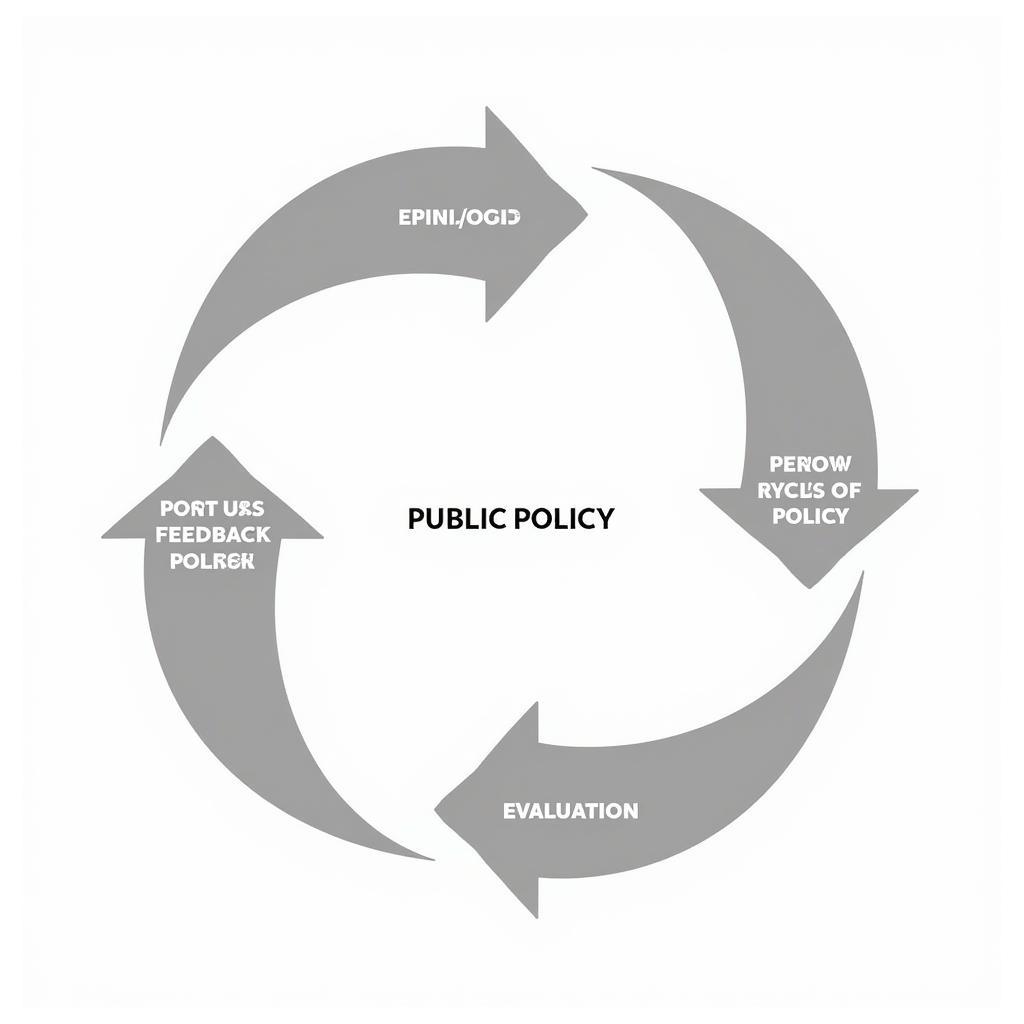
Public policy is a complex field that constantly evolves. Understanding the public policy cycle is crucial for evaluating its effectiveness and impact. This cycle encompasses various stages, from problem identification to policy evaluation and adjustment.
Stages of the Public Policy Cycle
The public policy cycle is typically divided into the following stages:
- Problem Identification: This stage involves defining and recognizing societal problems that require policy solutions. These problems can be identified by the government, social organizations, or the public.
- Policy Formulation: After identifying the problem, potential solutions are proposed and analyzed. This stage includes research, consultation with experts, and data collection.
- Decision-Making: This stage involves selecting the optimal solution and formalizing it into a policy. This decision is usually made by the legislative or executive branch.
- Policy Implementation: The enacted policy is put into action. This stage requires coordination between government agencies and stakeholders. Similar to military policy in the Cambodian battlefield, policy implementation requires close collaboration between involved parties.
- Policy Evaluation: After a period of implementation, the policy is evaluated for its effectiveness, impact, and any arising issues. The evaluation results are used to adjust and improve the policy.
Importance of Understanding the Policy Cycle
Understanding the policy cycle allows us to:
- Grasp the policy formation and development process: This enables more effective participation in policy planning.
- Evaluate policy effectiveness: By understanding the cycle’s stages, we can objectively and comprehensively assess policies.
- Propose policy improvements: Based on evaluation results, we can suggest changes and adjustments to enhance policy effectiveness. This is similar to how student loan policies need periodic evaluation and adjustments.
How the Public Policy Cycle Works
The public policy cycle is a continuous, iterative process. After evaluation, a policy can be adjusted, amended, or replaced with a new one.
The Public Policy Cycle Process
How to Participate in the Public Policy Cycle
Citizens can participate in the public policy cycle in various ways, such as:
- Attending public meetings.
- Submitting feedback to government agencies.
- Joining social organizations.
Conclusion
The public policy cycle is a complex but crucial process. Understanding this cycle helps us evaluate and improve policy effectiveness, contributing to societal development. Understanding the policy cycle also helps us better understand 8th-grade history on French colonial policies and other historical policies. Public policies should be continuously reviewed and adapted to the changing societal context. Similar to understanding the execution framework of practical policies, understanding the policy cycle aids in effective policy application and execution.
FAQ
- What is the public policy cycle?
- What are the stages of the public policy cycle?
- Why is understanding the policy cycle important?
- How can I participate in the public policy cycle?
- How does the public policy cycle affect my life?
- What is an example of the public policy cycle?
- Who is responsible for implementing the public policy cycle?
 Public Policy Cycle FAQs
You can learn more about related topics such as police penalties for citizen policy s61.
For assistance, please contact us at Phone: 0968239999, Email: [email protected] or visit us at: TT36 – CN9 Road, Tu Liem Industrial Zone, Phuong Canh Ward, Nam Tu Liem District, Hanoi. We have a 24/7 customer service team.









