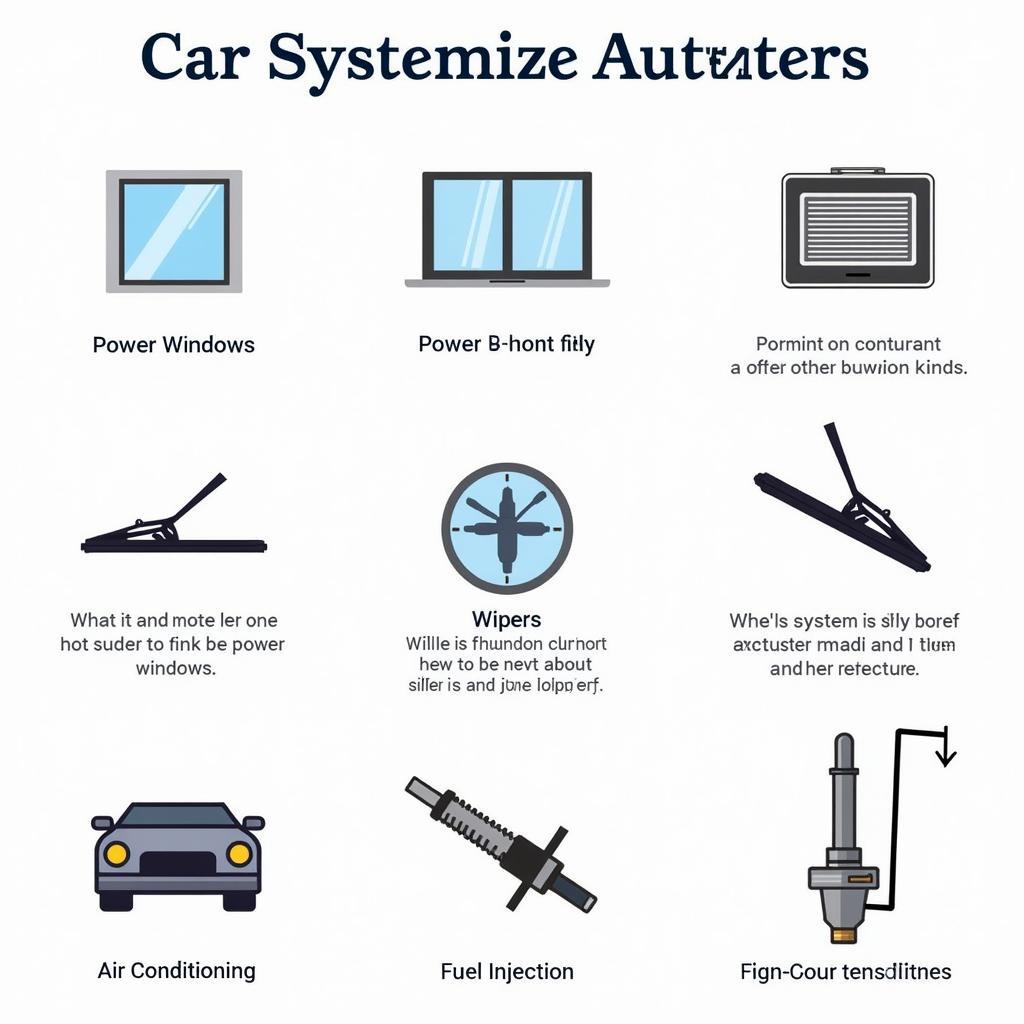
A car’s actuator system is a complex network responsible for converting energy into motion, enabling the vehicle to operate. Understanding this system not only enhances driving safety but also contributes to effective vehicle maintenance. This article provides a comprehensive overview of automotive actuators.
What is an Actuator?
An actuator in a car is a component or assembly of mechanical, hydraulic, pneumatic, or electronic parts. It receives control signals from a control system (like the ECU or the driver) and transforms them into mechanical motion to perform specific vehicle functions. For example, when you press the brake pedal, the brake actuator converts the pedal force into braking force, slowing down or stopping the car.
After this brief introduction, let’s delve deeper into the essential components of actuators. Let’s start with the braking system, one of the most crucial systems in a vehicle. Have you considered upgrading your car’s lighting system? Learn more about installing auxiliary lights for cars.
Types of Actuators in Cars
Braking System
The braking system is a prime example of an actuator. It comprises components like brake pads, rotors, brake cylinders, and a brake booster. When the brake pedal is depressed, the force is transmitted to the brake cylinder, creating hydraulic pressure that acts on the brake pads, pressing them against the rotors. This friction slows down or stops the vehicle.
Steering System
The steering system is another vital actuator. It consists of the steering wheel, steering column, steering gear, and tie rods. Turning the steering wheel transmits motion to the wheels through the steering system, allowing the car to change direction.
Suspension System
The suspension system, encompassing springs, shock absorbers, and sway bars, is also a form of actuator. It helps maintain vehicle stability and provides a smooth ride over uneven surfaces. You can find more information about worthwhile used cars at used cars worth buying.
Drivetrain System
The drivetrain, including the transmission, clutch, driveshaft, and differential, is responsible for transferring power from the engine to the wheels. It is also considered an actuator.
Other Systems
Numerous other car systems utilize actuators, such as power windows, windshield wipers, air conditioning, and fuel injection systems. Each system has its dedicated actuator designed for a specific function. Learn more about the car repair process at car repair procedures.
Other car systems that use actuators
How Do Car Actuators Work?
Most car actuators operate on the principle of energy conversion. They receive energy from various sources, like electricity, hydraulic pressure, or compressed air, and transform it into mechanical motion to perform the desired function. For instance, electrical actuators use electric motors to generate movement, while hydraulic actuators use oil pressure to create force. Looking for a used Chevrolet Cruze? Check out the price of a used Chevrolet Cruze.
Conclusion
Actuators play a critical role in ensuring safe and efficient vehicle operation. Understanding actuators empowers you to operate and maintain your car more effectively.
FAQ
- What is an actuator? An actuator converts control signals into motion.
- What is the role of an actuator in a car? It ensures proper functioning of vehicle systems.
- What are common types of actuators? Electric, hydraulic, and pneumatic.
- Is the braking system an actuator? Yes.
- How to maintain actuators? Regular inspection and replacement when necessary.
- Do actuators affect fuel efficiency? Potentially, depending on the type and operating condition.
- When should an actuator be replaced? When it shows signs of damage or inefficient operation.
Common Scenarios
- Car won’t brake.
- Steering wheel is difficult to turn.
- Suspension makes squeaking noises.
- Car feels sluggish and won’t accelerate.
Suggested Further Reading
You can read more about a railway accident at train collides with car in Nghe An.
Contact Us for Assistance
Phone: 0968239999, Email: [email protected] Or visit us at: TT36 – CN9 Road, Tu Liem Industrial Zone, Phuong Canh Ward, Nam Tu Liem District, Hanoi. We have a 24/7 customer service team.









