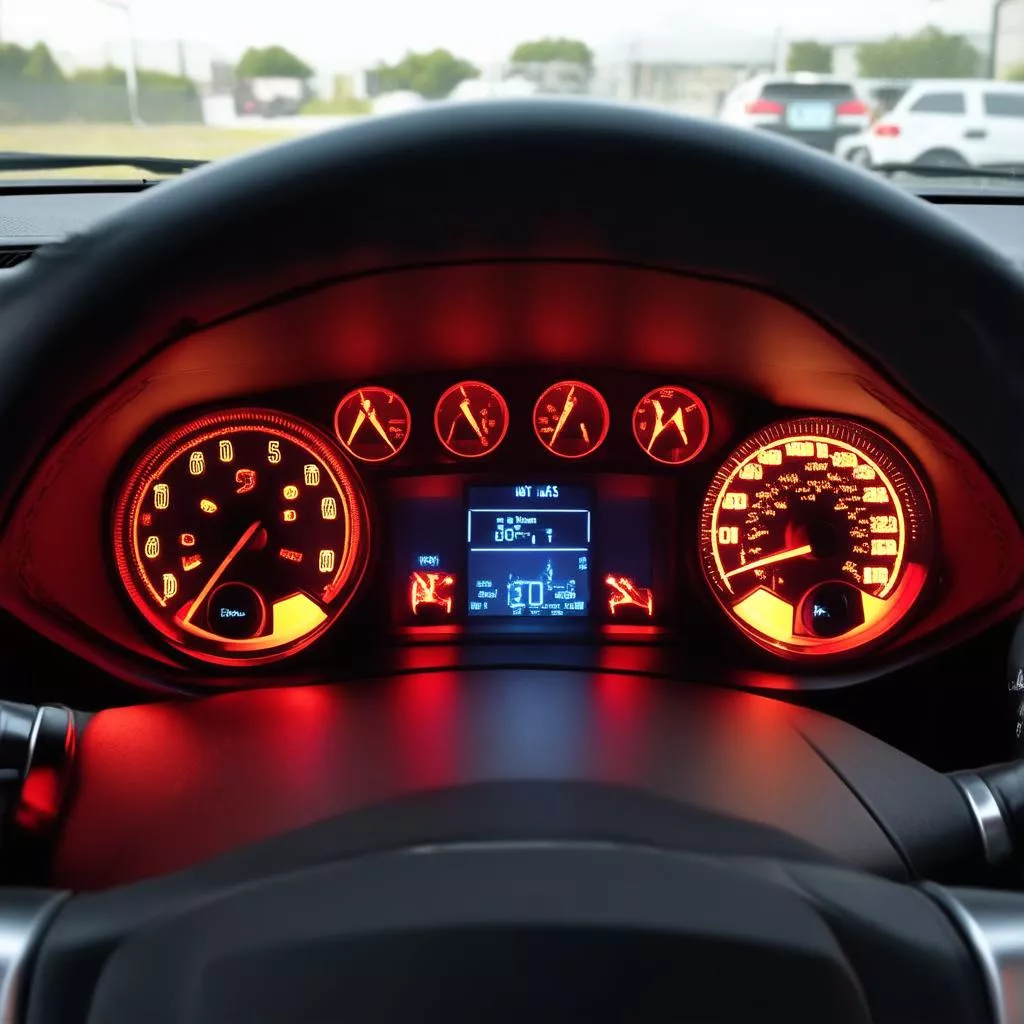
Have you ever wondered why your car has so many warning lights, each with a unique meaning? Have you ever been puzzled by a flashing light on your dashboard, unsure if your car is experiencing a problem? Let’s explore the world of car warning lights – a crucial system that helps protect you and your vehicle from potential dangers.
The Importance of Understanding Car Warning Lights
Understanding car warning lights is paramount for any driver. Knowing the meaning and function of each light empowers you to proactively maintain your vehicle, ensuring your safety and the safety of others.
Technical Significance
Car warning lights are an integral part of a vehicle’s electronic system. This system utilizes sensors, circuits, and control units to detect anomalies in various car components. When an issue is detected, a warning light illuminates, alerting the driver to the problem and the need for timely action.
Psychological Significance
Car warning lights play a crucial role in providing drivers with a sense of safety and security. Seeing a warning light allows drivers to react promptly, effectively manage the situation, and prevent potential accidents.
Decoding the Lights
Common Types of Car Warning Lights:
- Warning Lights: Indicate potential dangers, such as emergency warning lights (e.g., engine fire warning, low oil pressure warning).
- System Warning Lights: Indicate the operational status of various car systems, such as the engine warning light, the ABS (Anti-lock Braking System) warning light, and the airbag warning light.
- Level Warning Lights: Indicate the level of a specific element, such as the fuel level warning light and the engine oil level warning light.
How to Use Warning Lights:
- Understand the meaning of each light: Familiarize yourself with the meaning of each warning light in your car. This information is usually detailed in your car’s owner’s manual.
- Pay attention to warning lights: Always monitor the warning lights on your dashboard. If a light illuminates, safely stop your car and investigate the cause.
- Never ignore warning lights: Ignoring illuminated warning lights can lead to serious consequences.
Argument, Evidence, and Verification
Argument: Car warning lights are a vital system that helps drivers detect and address potential hazards, ensuring their safety and the safety of others.
Evidence:
- Leading traffic safety experts, such as Dr. James Wilson, author of “Traffic Safety: A Driver’s Guide,” assert: “The warning light system plays a crucial role in preventing traffic accidents. When a warning light illuminates, it signifies a problem with the vehicle that requires immediate attention. Ignoring warning lights can have severe consequences.”
- Scientific studies have demonstrated that the use of warning lights significantly reduces the number of traffic accidents.
Verification:
- Basic issues, like an illuminated engine warning light, can often be resolved with simple actions, such as checking the engine oil level or replacing the air filter.
- Serious issues, like an illuminated ABS warning light, require attention from qualified technicians.
Common Scenarios:
- Illuminated Engine Warning Light: Can be caused by various factors, such as low engine oil, faulty spark plugs, or a malfunctioning fuel injection system.
- Illuminated ABS Warning Light: Can be caused by a faulty ABS sensor or a problem with the braking system.
- Illuminated Airbag Warning Light: Can be caused by a software error or a faulty airbag sensor.
How to Respond:
- Consult your car’s owner’s manual: The owner’s manual provides detailed information about the meaning of each warning light, troubleshooting steps, and important precautions.
- Check the engine oil level: If the engine warning light is on, check the engine oil level and add oil if necessary.
- Take your car to a repair shop: If a warning light illuminates and you cannot resolve the issue yourself, take your car to a qualified repair shop for diagnosis and repair.
Related Questions:
- What are the most common car warning lights?
- How do I check and address warning lights when they illuminate?
- Can I fix warning light issues myself?
- What does each warning light on the dashboard mean?
Related Products:
- Car Diagnostic Tool: Allows you to check and troubleshoot warning lights at home.
- Car Owner’s Manual: Provides detailed information about the meaning of each warning light and troubleshooting steps.
Suggested Further Reading:
- https://xetaihanoi.edu.vn/muc-xu-phat-o-to-vuot-den-do/ – Penalties for Running Red Lights
- https://xetaihanoi.edu.vn/cach-lap-den-canh-bao-mo-cua-o-to/ – How to Install Car Door Warning Lights
- https://xetaihanoi.edu.vn/cac-den-canh-bao-tren-o-to/ – Car Warning Lights
- https://xetaihanoi.edu.vn/cac-den-canh-bao-tren-xe-o-to/ – Car Warning Lights
- https://xetaihanoi.edu.vn/muc-phat-o-to-vuot-den-do/ – Penalties for Running Red Lights
Call to Action:
If you have any questions about car warning lights, contact us for a free consultation. The XE TẢI HÀ NỘI team of experts is available to assist you 24/7. If you are interested in purchasing a truck, please contact us via Hotline: 0968 239 999.
Conclusion:
Car warning lights are a crucial system that helps protect you and your vehicle from potential hazards. Pay attention to warning lights, understand their meanings, and address them promptly to ensure safe driving.
Share this article with your friends and family to help them learn more about car warning lights!
Car warning lights dashboard Check engine light









