The Paris Commune, a revolutionary socialist government that existed for a brief 72 days in 1871, left an indelible mark on world history. Its organizational structure and policies, though imperfect, laid the groundwork for many subsequent socialist ideas. This article delves into the organizational structure and notable policies of the Paris Commune.
Organizational Structure of the Paris Commune
The Paris Commune was organized based on the principle of direct democracy, eliminating the distinction between legislative and executive branches. The highest authority was the Commune Council, elected by all Parisians through universal suffrage. The Commune Council was responsible for all matters of the city, from legislation and administration to justice.
The Commune Council: The Center of Power
The Commune Council consisted of 92 representatives, elected by district. The Council operated publicly and under the close scrutiny of the people. Council members could be recalled at any time if they failed to fulfill their duties or lost the confidence of their constituents.
Specialized Committees
To manage specific areas, the Commune Council established specialized committees, such as the Military Committee, Finance Committee, Education Committee, and Labor Committee. These committees were responsible for implementing the policies set forth by the Commune Council and reporting their activities to the Council.
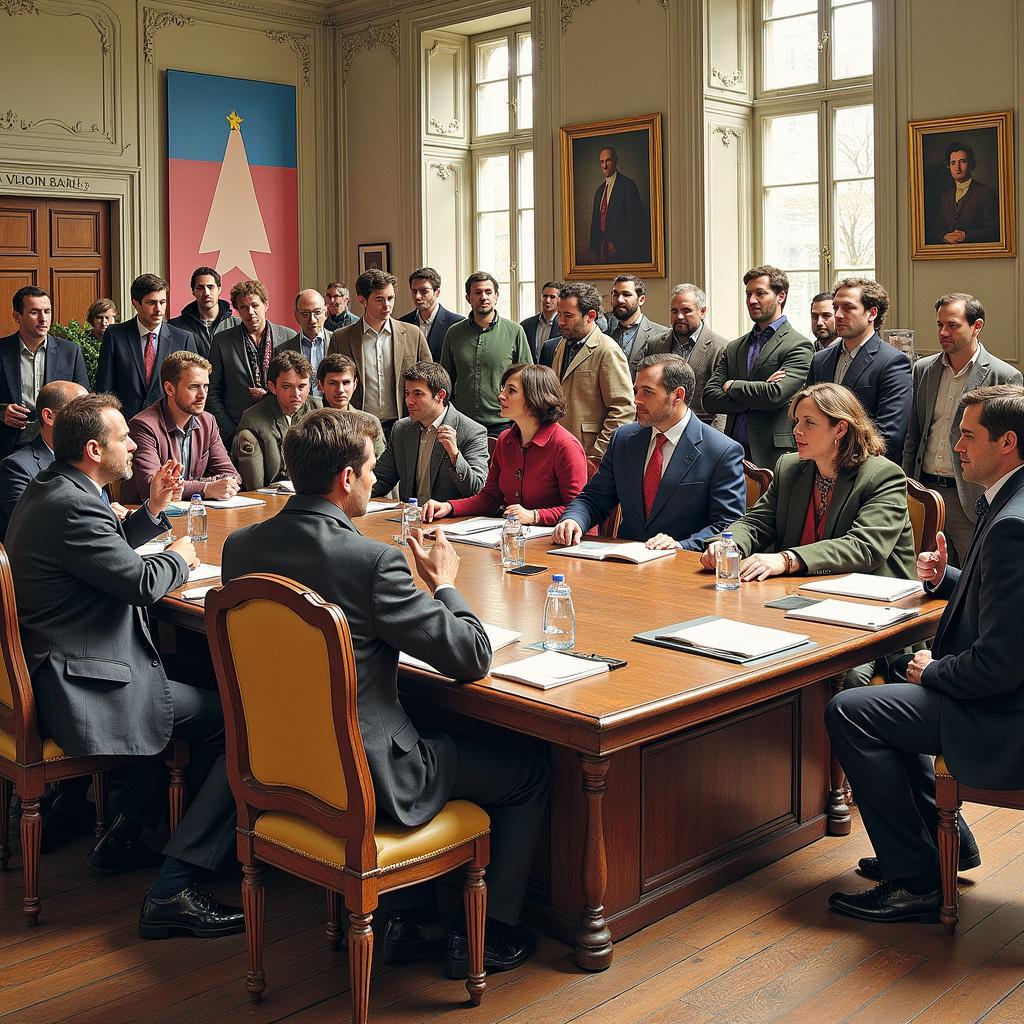
Paris Commune Council meeting
Progressive Policies of the Paris Commune
The Paris Commune implemented a series of progressive policies aimed at improving the lives of the people and building a more just society. Some notable policies included:
- Separation of Church and State: The Paris Commune declared the separation of church and state, confiscated church property, and used it for public purposes.
- Suffrage: All Parisian citizens, including women, had the right to vote and run for the Commune Council.
- Educational Reform: The Paris Commune implemented educational reform, making education free and compulsory for all children.
- Improved Working Conditions: The Paris Commune enacted policies to protect workers’ rights, limit working hours, and improve working conditions.
Socio-Economic Policies
The Paris Commune nationalized abandoned factories and placed them under the management of workers. This was considered a significant step in realizing the working class’s right to ownership.
Military Policy
The Paris Commune established the National Guard, comprising all citizens capable of fighting, to defend the city from attacks by the Versailles government army.
Historical Impact of the Paris Commune
Despite its short lifespan, the Paris Commune had a profound impact on the international communist and workers’ movements. Its organizational structure and policies, though imperfect, became a source of inspiration for working-class liberation struggles worldwide.
Conclusion
The organizational structure and policies of the Paris Commune, though short-lived, embodied the aspirations for a just, democratic, and progressive society. Despite its failure, the Paris Commune left valuable lessons for the communist and workers’ movements internationally, contributing to the development of socialist thought.
FAQ
- How long did the Paris Commune last? (72 days)
- What was the highest authority of the Paris Commune? (The Commune Council)
- In what year was the Paris Commune established? (1871)
- What was the main goal of the Paris Commune? (To build a just and democratic society)
- Why did the Paris Commune fail? (It was suppressed by the Versailles government army)
- What impact did the Paris Commune have on history? (It inspired the international communist movement)
- What were some of the notable policies of the Paris Commune? (Separation of Church and State, educational reform, improved working conditions)
Common Questions and Concerns
People often wonder about the feasibility of the Paris Commune model and its limitations. Common questions include its military organization, economic management, and the lack of experience of its leaders.
Suggested Further Reading
You can learn more about French history, other revolutions, or different political models on our website.









