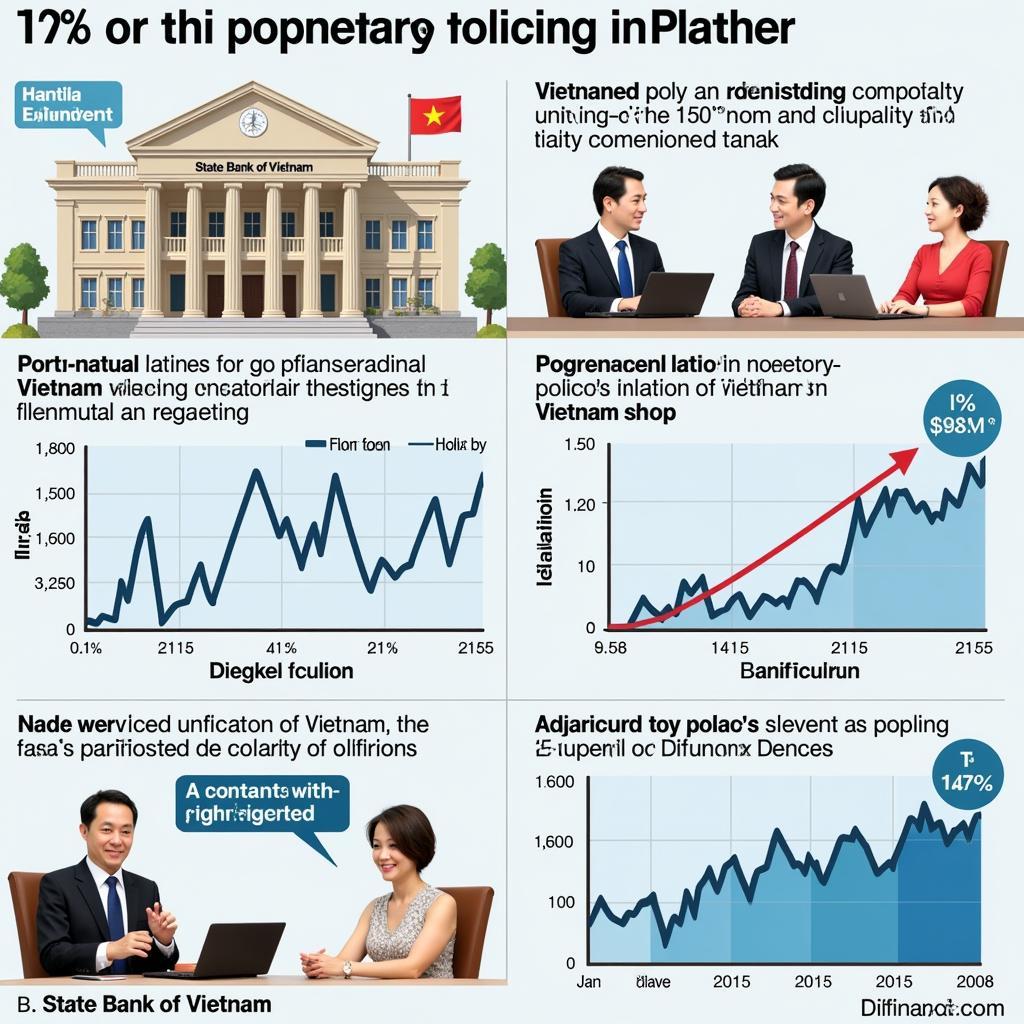
Monetary policy plays a crucial role in Vietnam’s macroeconomic stability and growth. This article delves into its use, examining the tools, objectives, and challenges involved.
Objectives of Monetary Policy
Vietnam’s monetary policy aims to control inflation, stabilize exchange rates, and support sustainable economic growth. Balancing these objectives requires flexibility and adjustments based on prevailing economic conditions. The State Bank of Vietnam (SBV) is the primary authority responsible for formulating and implementing monetary policy. At the beginning of each year, the SBV typically announces target orientations for monetary policy, providing a framework for operational activities throughout the year. A fixed exchange rate policy has been applied during certain periods.
Vietnamese monetary policy controlling inflation
Tools of Monetary Policy
The SBV utilizes various tools to adjust money supply and influence market interest rates. Key instruments include: reserve requirement adjustments, open market operations (OMO), and refinancing rate adjustments. Using these tools in combination allows the SBV to better control money flow within the economy. For instance, OMO is used flexibly to regulate short-term liquidity in the interbank market, while the reserve requirement ratio affects the lending capacity of commercial banks.
Reserve Requirement Ratio
The reserve requirement ratio is the percentage of deposits that commercial banks must hold at the SBV. Changes to this ratio directly impact the banks’ lending capacity. The policy impact is clearly demonstrated through this tool.
Open Market Operations (OMO)
OMO involves the SBV buying or selling government bonds in the open market to increase or decrease the money supply. This is a commonly used tool for adjusting short-term liquidity.
Refinancing Rate
The refinancing rate is the interest rate at which the SBV lends to commercial banks. Adjustments to this rate influence lending rates in the market. The concept of trade policy is also closely related to monetary policy.
Challenges in Implementing Monetary Policy
Implementing monetary policy in Vietnam faces several challenges, including inflationary pressures, exchange rate fluctuations, and the impact of the global economy. The negative aspects of the 2016 monetary policy serve as a prime example. Furthermore, the underdeveloped financial market presents difficulties in policy execution.
Nguyen Van A, an economist at the Institute for Economic and Development Research, stated: “Monetary policy management needs to be flexible and timely to respond to economic fluctuations.”
Tran Thi B, Director of Bank C, commented: “Close coordination between monetary and fiscal policy is crucial for ensuring the effectiveness of macroeconomic policy.”
Conclusion
Monetary policy in Vietnam plays a vital role in macroeconomic stability and growth support. The SBV needs to continue improving the legal framework, enhancing forecasting and analytical capabilities, and strengthening coordination with other ministries and agencies to ensure the effectiveness of monetary policy. The Vinsmart return policy is an example of a specific policy.
FAQ
- What is monetary policy?
- What are the main objectives of monetary policy in Vietnam?
- What tools does the SBV use to manage monetary policy?
- What is the biggest challenge for monetary policy implementation in Vietnam?
- How does monetary policy affect citizens?
- How can I stay updated on monetary policy information?
- How is monetary policy related to fiscal policy?
Common Scenarios and Questions about Monetary Policy in Vietnam
- Scenario 1: High Inflation. When inflation rises, the SBV can tighten monetary policy by increasing interest rates and reducing money supply to curb inflation.
- Scenario 2: Economic Recession. During an economic downturn, the SBV can loosen monetary policy by decreasing interest rates and increasing money supply to stimulate the economy.
Suggested Related Articles and Questions
- What is fiscal policy?
- What is the relationship between monetary and fiscal policy?
For assistance, please contact us at Phone: 0968239999, Email: [email protected] or visit us at: TT36 – CN9 Road, Tu Liem Industrial Zone, Phuong Canh Ward, Nam Tu Liem District, Hanoi. We have a 24/7 customer support team.