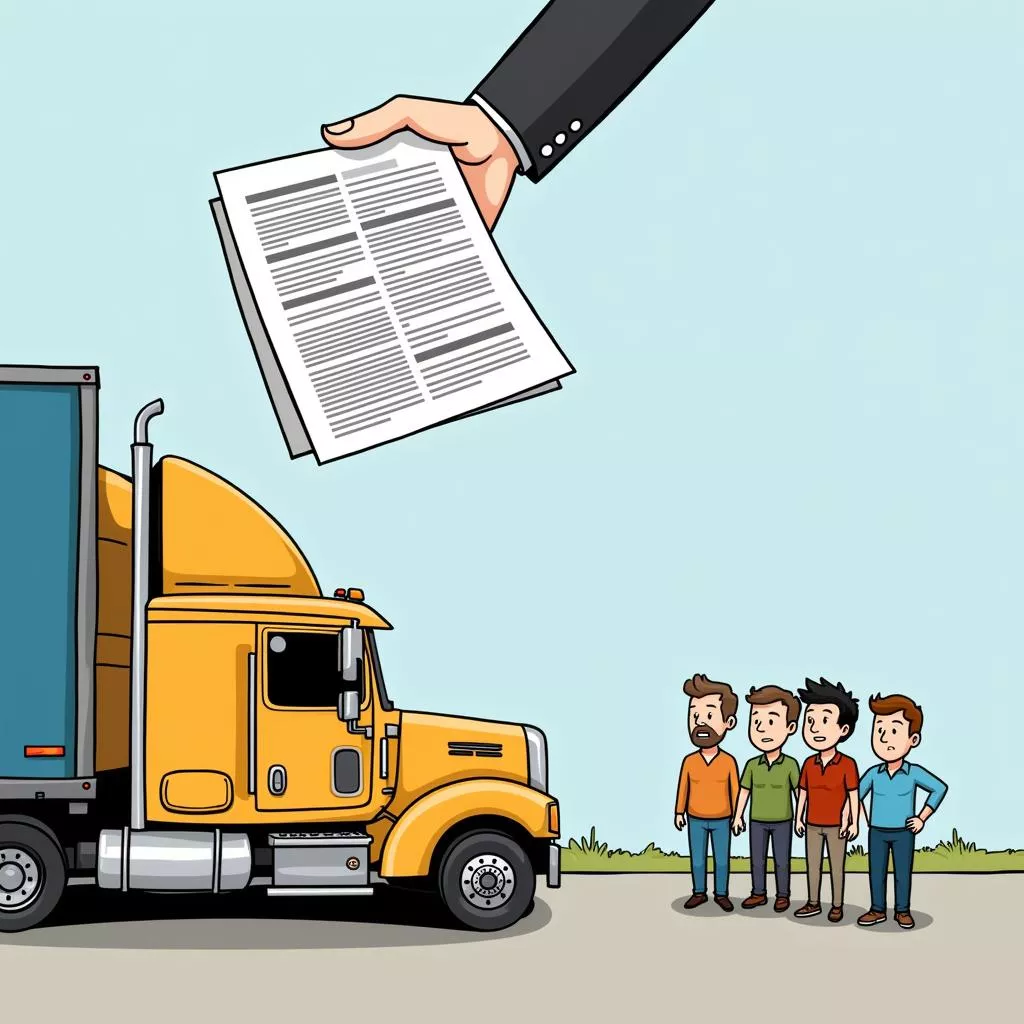
“Policy reversal” can be disheartening news. It can feel like hope and trust are being dismantled piece by piece. Just like a friend of mine who finally saved enough to buy a truck, excitedly signing up for a transport support program, only to have it abruptly revoked. Now, driving feels like carrying an extra ton of burden.
Image of truck support policy being revoked
## Adaptive Policy Reversal: More Harm Than Good or Necessary Adjustment?
Policy reversal simply means the government puts a policy on hold or cancels it entirely. Reasons vary: the policy might be outdated, resources may be scarce, or worse, the policy might have negative economic consequences.
“Adaptive policy reversal” refers to policies enacted during emergencies, like the recent Covid-19 pandemic, being overturned.
 Truck transporting goods during the pandemic
For instance, tax exemptions for trucks were implemented to ease supply chain disruptions. Initially, drivers and businesses celebrated. But the relief was short-lived; as the pandemic subsided, the policy expired.
Policy reversals are a double-edged sword. They allow the government to adjust the economic course and optimize resources. However, they can also destabilize individuals and businesses due to rapidly changing rules.
## Lives Disrupted by Shifting Policies
“Adaptive policies” can be like sudden downpours, appearing and disappearing quickly. People and businesses accustomed to the “sunshine” of old policies must scramble to adapt to the new “storm.”
My friend, after the transport support was revoked, felt like a chess player losing a crucial piece. Profits vanished while loan payments remained. Driving became a source of anxiety and uncertainty about the future.
### Economic Instability
Poorly managed adaptive policy reversals can destabilize the economy. Businesses lose direction, and uncertainty breeds hesitation. For example, a sudden reversal of ineffective fiscal policies related to roads, could freeze the real estate market, triggering further consequences.
### Eroding Trust
While compromise is essential in transactions, constant policy shifts erode trust and discourage investment. Hasty and opaque reversals damage public faith in the government, similar to Tiki’s freeship policy initially attracting customers but later disappointing them with changes.
## Balancing Act: A Challenge for Policymakers
 Adaptive truck policy in Hanoi
Policymakers face a dilemma when considering adaptive policy reversals. Each option presents its own set of challenges.
Nguyen Van A, an economist at the National Economics University, states: “Policy reversals must be implemented cautiously, with a clear roadmap, to avoid shocking the economy.” He also emphasizes the need for support measures for those affected, such as financial aid and vocational training.
## Untangling the Policy Reversal Puzzle
Solving the policy reversal puzzle requires coordinated efforts between the government, businesses, and citizens, similar to navigating the pros and cons of salary reform policies.
For the Government:
- Conduct thorough impact assessments before enacting or reversing policies.
- Ensure transparent, clear, and timely information dissemination.
- Provide adequate support for affected individuals and businesses.
For Businesses:
- Stay updated on policy changes.
- Adapt business plans accordingly.
For Citizens:
- Thoroughly understand policies before making investment decisions.
Conclusion
“Adaptive policy reversal” is a sensitive issue requiring careful, scientific, and humane implementation. The ultimate goal of any policy is to improve people’s lives. This journey requires collaboration and unity across the political system and society as a whole.
Want to learn more about US monetary policy? Or are you interested in Vietnamese business management policies? Leave a comment below to join the discussion!
Need Assistance?
Contact us:
- Phone: 0968239999
- Email: [email protected]
- Address: No. TT36 – CN9 Road, Tu Liem Industrial Zone, Phuong Canh Ward, Nam Tu Liem District, Hanoi.
We are available 24/7!









